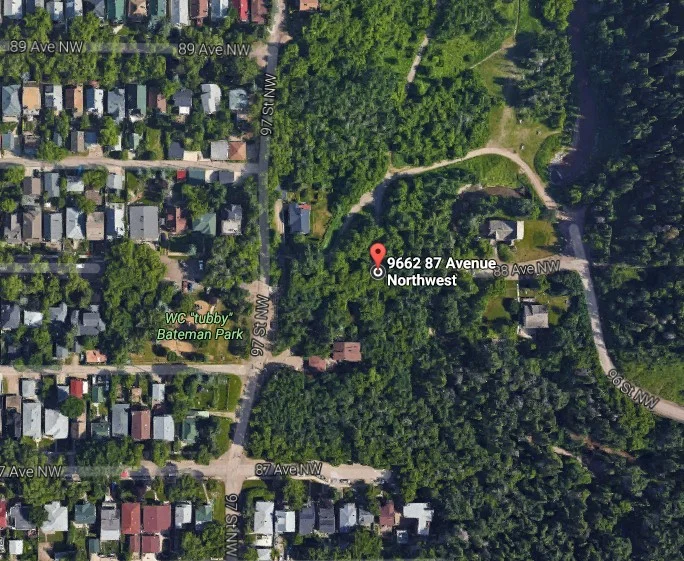
The shared-use path in Mill Creek near 88 Avenue will be closed for approximately 5 hours some time on April 13, 2017.
In preparation for the construction site of the new overflow tunnel along the alignment of 88 Avenue, west of Mill Creek, the City of Edmonton’s crew will conduct hydro excavation work from the surface down to expose and verify the location of buried utilities close to the site of the shaft that will be used for construction.
This work will take five hours to complete on April 13th, 2017, and will interrupt the bike lane at the work site location as indicated on the map in the attached notice.
Join us April 11, 2017 between 6pm-9pm at the MEC South Edmonton Common location (1624 99 Street NW) for club night.
10% discount for EBC members on all regular-price items, including bikes and boats. Door prizes will be awarded throughout the night!
Please note that you must be a member of MEC ($5 lifetime membership) and EBC ($15-$20 annual membership) to take advantage of this discount. Both memberships will be available for purchase the night of this event.
All regular priced merchandise is 10% off – even bikes and boats. Products on clearance or marked down or products that get a discount from packages are not eligible for the 10% discount. Discount applies only to items that are in stock in the store at the time of the club night. No store transfers or web purchases. Blundstone footwear is exempt from this discount.
Paths for People is hiring for two part-time positions: an Administrator/Coordinator and an Executive Director.
If you'd like a position promoting and advocating for active transportation and better infrastructure in Edmonton, or if you know someone who would be a good candidate, check out these job postings with a fantastic organization.
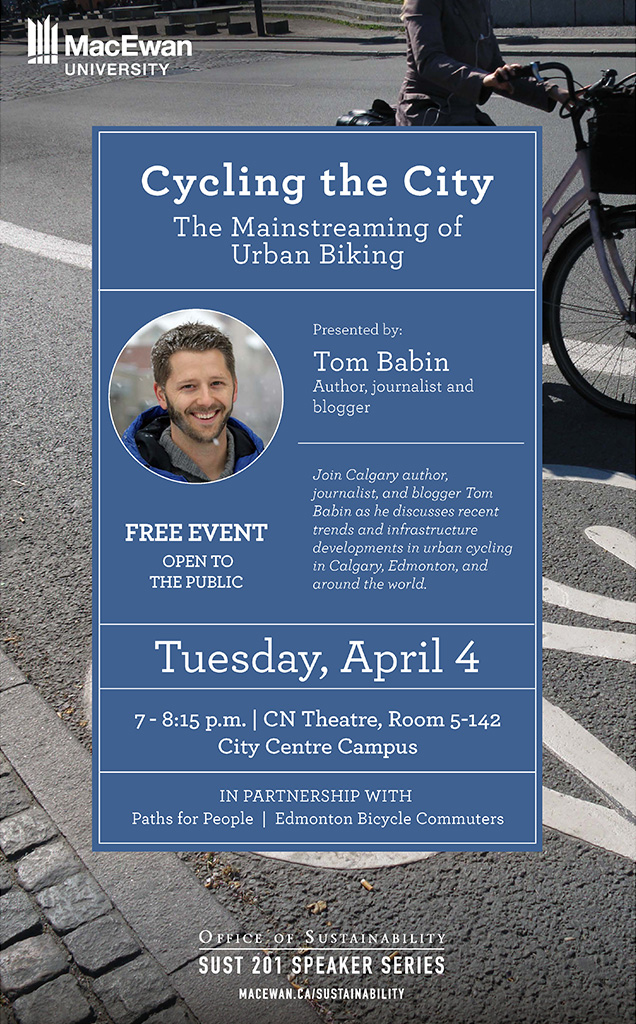
Please attend tonight's free presentation, Cycling the City: The Mainstreaming of Urban Biking, Tuesday, Apr 4 2017, from 7pm-8:15pm at the CN Theatre (Room 5-142), City Centre Campus, MacEwan University (the first floor of the the 105 St building on 104 Avenue).
Presented by Tom Babin and hosted by the MacEwan University Office of Sustainability as part of their Sustainability Speaker Series.
Cycling is rapidly growing in popularity as a means of getting around North American cities, even winter cities. More and more places are introducing cycling-specific infrastructure to provide safer dedicated routes for cyclists, pedestrians, and motorists.
This summer, Edmonton launches its downtown grid of separated bike lanes. Calgary author, journalist, and blogger Tom Babin looks at recent trends and infrastructure developments in urban cycling in Calgary, Edmonton, and around the world.
Presented by: Tom Babin
Tom is a Calgary-based author, journalist, and blogger who has written for the Los Angeles Times, National Post and Explore, and has spoken about cycling all over the world. He is also the author of Frostbike: The Joy, Pain, and Numbness of Winter Cycling.
In partnership withPaths for People and the Edmonton Bicycle Commuters Society.
EBC is hiring a Bicycle Assembler. This position will help EBC provide bicycles to the public by building a steady supply of refurbished bikes for sale, maintaining and repairing EBC's rental bike fleet, and sharing knowledge and experience with EBC's volunteer mechanics.
If you have strong bicycle mechanic skills, the ability to work independently, and a desire to support our non-profit in helping more people to ride bikes, please consider applying.
Application deadline is February 17, 2017. Please submit applications and inquiries to [email protected].
Join us for our fall MEC/EBC Club Night at the downtown MEC (12328 102 Ave) on Tuesday, November 29 from 7-9pm!
EBC members can purchase regular priced merchandise at 10% off – even bikes and boats. Products on clearance or marked down or products that get a discount from packages are not eligible for the 10% discount.
Door prizes will be awarded throughout the night!
Please note that you must be a member of MEC ($5 lifetime membership) and EBC ($15-$20 annual membership) to take advantage of this discount. Both memberships will be available for purchase the night of this event.
Iif you have your EBC membership card, please bring it, though it is not required. As long as you are a current member of EBC, we can verify your membership online and/or issue you a new card on the evening of the event.
Discount applies only to items that are in stock in the store at the time of the club night. No store transfers or web purchases.
Following in Calgary's footsteps, Edmonton City Council has unanimously approved building a network of protected bike lanes through downtown Edmonton, to open summer 2017.
Thank you for sending us your stories, and for writing to your councillors, and a huge thanks to Paths for People for their work to make this happen. Please join Paths for People if you haven't already, and follow them on Facebook and Twitter.
“We have been just inundated with demand from people who want to cycle and just don’t feel safe,” said Coun. Scott McKeen, urging his colleagues to vote for the plan.
Please write to your councillor one more time: to join us in thanking them for their leadership and for supporting this decision.
#yegcc unanimously passes #yegbike grid. Mayor @doniveson adds motion to see if it could be expanded into University/Strathcona area in 2018
You can also send a tweet to Keith Shillington, Senior VP at Stantec, @shillington_k thanking him and Stantec for their initiative and the donation of their resources in developing this plan.
Edmonton's Downtown Grid
Stantec donated resources to develop a downtown bike network plan. The City of Edmonton has already started more detailed design work. The current plan is to open the grid by the summer of 2017; city administration has agreed that this is feasible, though an aggressive schedule. You can read a summary of the plan here.
Councillor Scott McKeen brought forward the original motion to study a minimum grid in July, with Coun. Ben Henderson amending it to consider a minimum grid including the entire core, including Old Strathcona. Due to constricted resources and timelines, Stantec's report only studied the downtown, but Mayor Don Iveson added a motion on Tuesday to look at using provincial or federal grants to help expand the grid to the University/Strathcona area in 2018.
You can watch video of the vote and view the bike grid reports by clicking on agenda item 6.12.
Contact your provincial and federal representatives
Federal Transportation Minister Amarjeet Sohi has responded, "We are seriously exploring how do we support municipalities to build the sustainable modes of transportation, dedicated cycling infrastructure, or other ways to reduce our dependency on the personal automobile.”
You can contact your provincial and federal representatives to ask them to support active transportation funding for municipalities, which will help Edmonton to expand the grid to Strathcona:
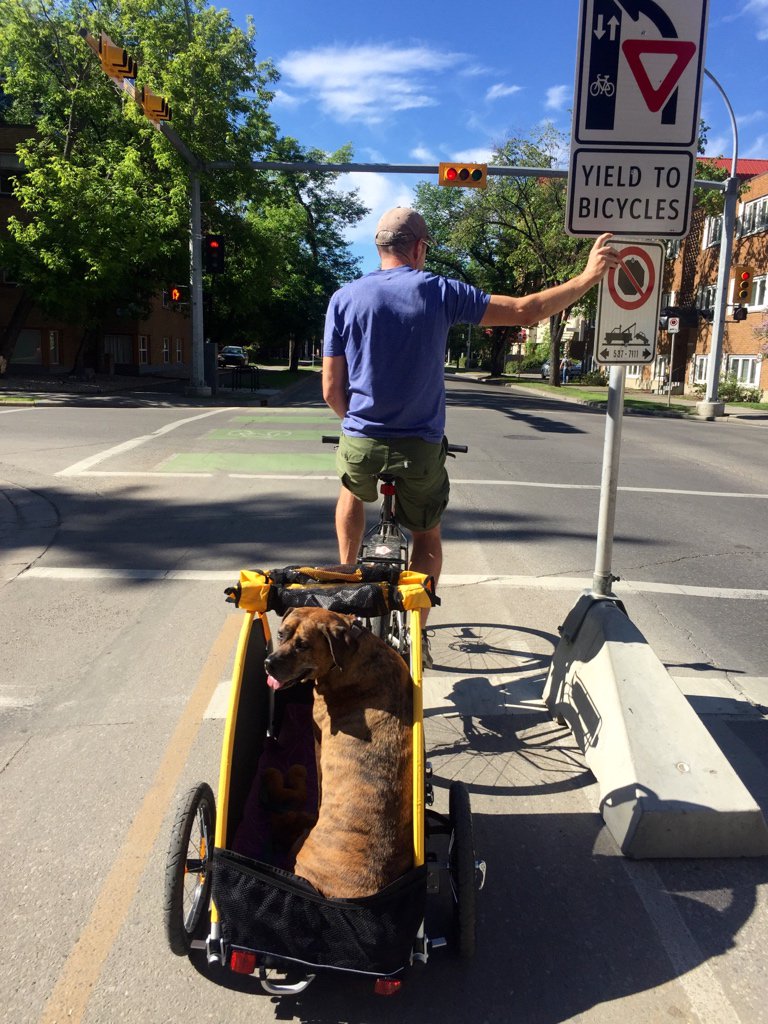
Edmonton's bike grid is specifically designed for Edmonton, with very careful analysis of each road, but the concept is modelled after Calgary's downtown bike grid, which was also designed by Stantec. Their grid, which only opened in 2015, has been hugely popular.
In 2011, there were just six communities in Calgary where at least four per cent of respondents reported commuting by bike. In 2016, that had risen to 43 communities. Ridership on some stretches of their network has doubled, tripled, or even quadrupled in two years.
Next steps
As Edmonton pushes forward with its bike network, two priorities emerge:
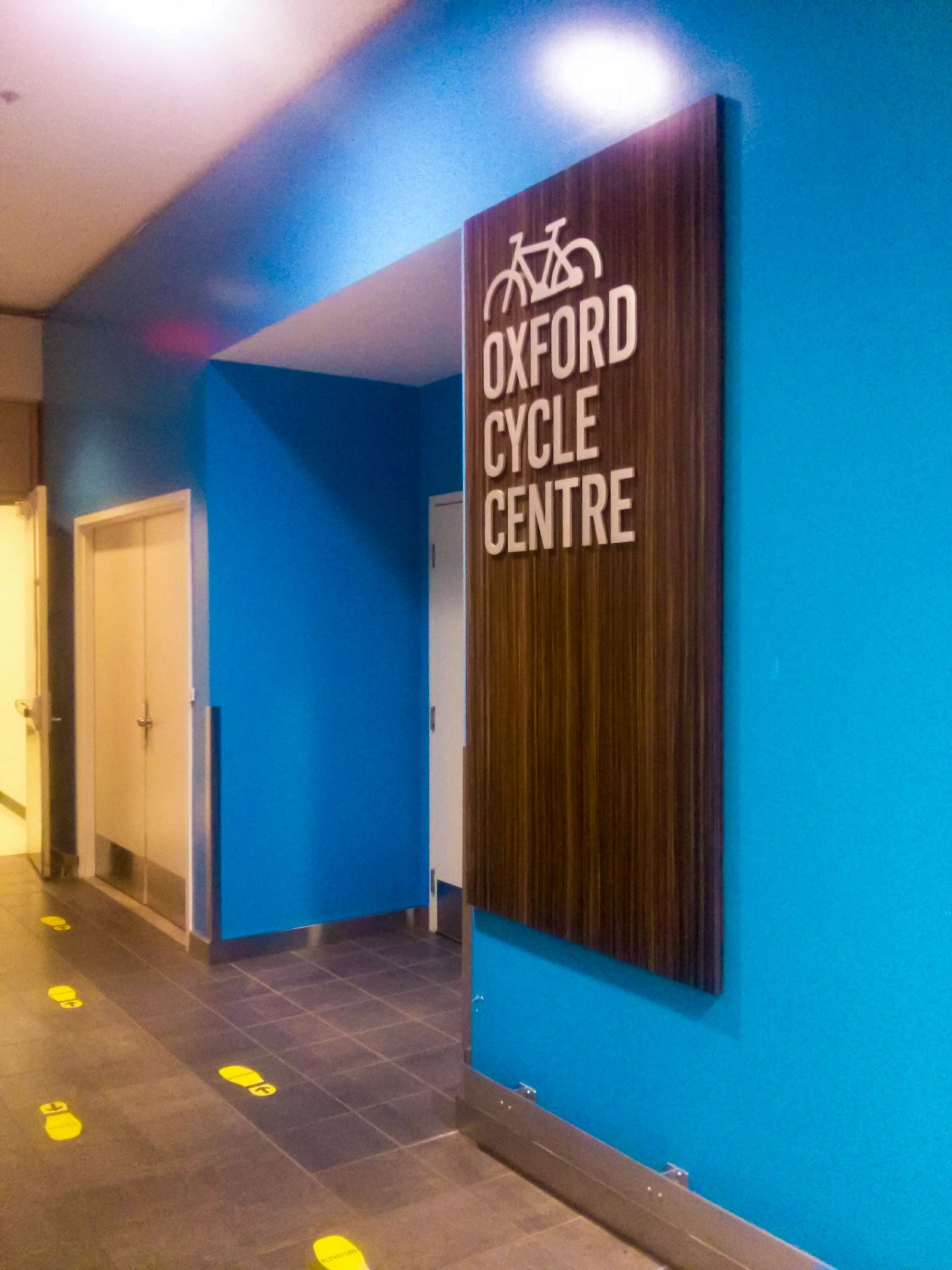
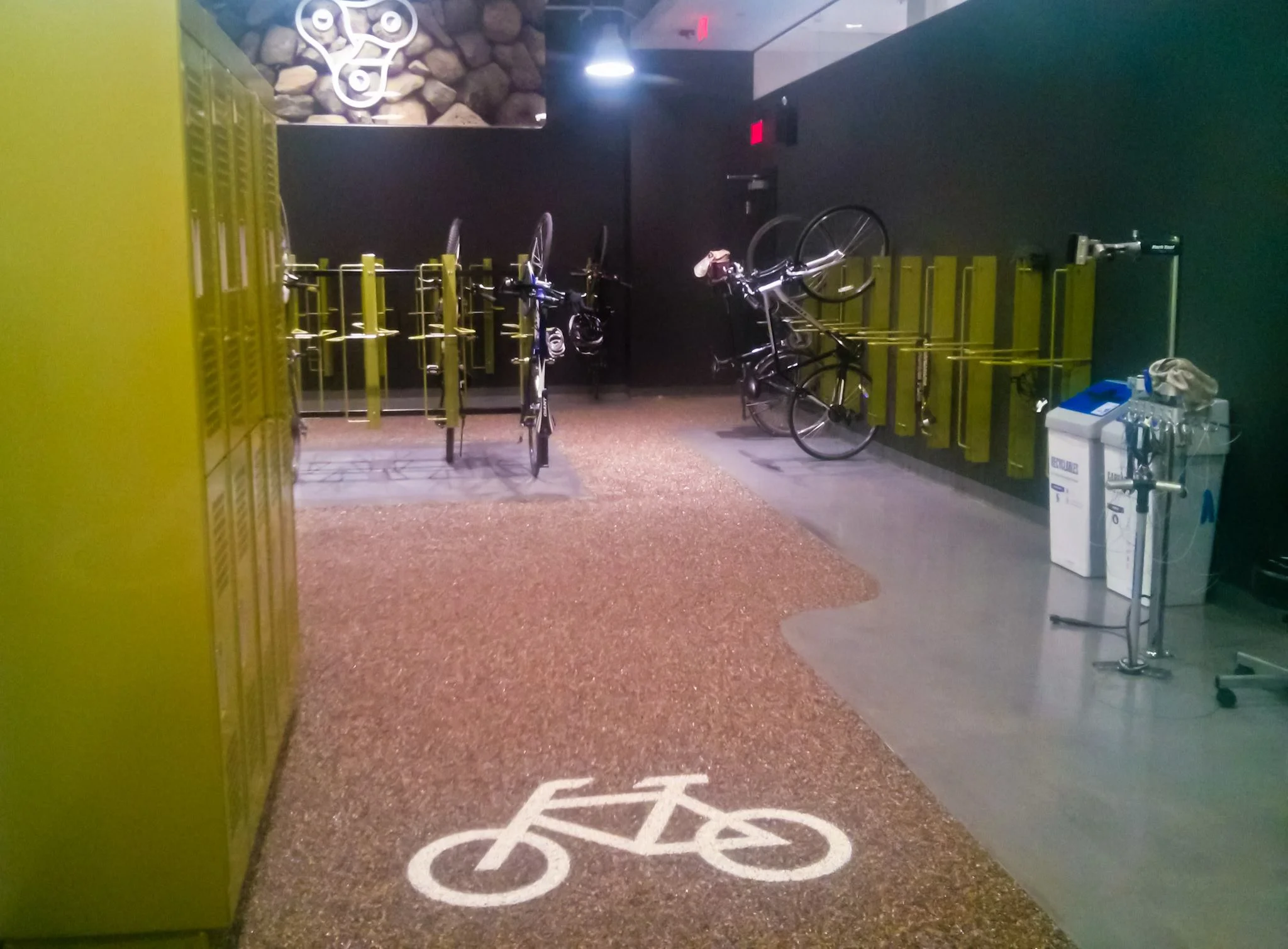
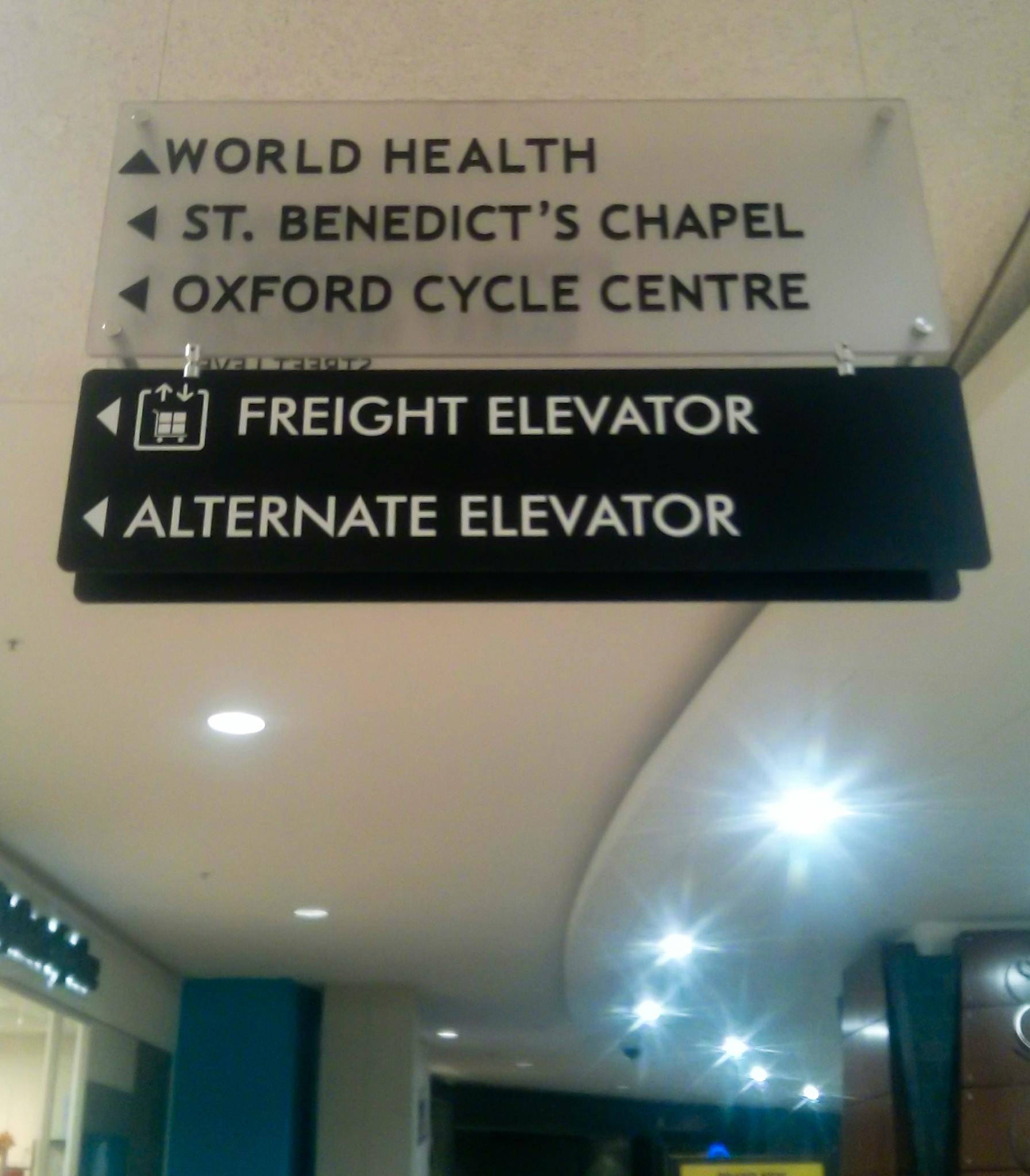
Secure bike parking: Are there enough places downtown for commuters to secure their bikes? If you are concerned about the facilities in your workplace, please talk to your building manager, or get in touch with us. The Oxford Cycle Centre in Edmonton City Centre Mall, provided exclusively for staff in that building and tower complex and easily accessed through an attached parkade, includes lockers, showers, towel service, a bike washing station, and a bike repair stand with pump and tools:
Strathcona/University area:Contact your provincial and federal representatives to express support for providing funding to municipalities for active transportation projects, so that Edmonton can expand the grid in 2018. Also tell Brian Mason that you support a High Level Park across the upper deck of the High Level Bridge, so that we can properly connect the north and south sides.
Thank you again to the Mayor, City Council, Paths for People, Stantec and everyone that wrote in support of the downtown grid. We are excited to celebrate this momentous turning point for Edmonton.
EBC is seeking an independent contractor to provide the Society with bookkeeping services.
Start date: November 2016
Qualifications:
Accounting designation or relevant bookkeeping experience with not-for-profit and charitable organizations.
Experienced with accounting software and Google programs. Training for specific programs will be available through EBC Treasurer and Executive Director mentorship.
Based in Edmonton or surrounding area.
Familiarity with EBC programs and services is an asset.
Please review the full job posting for details, including how to apply.
Application deadline is November 1, 2016.
We thank all applicants for your interest; however only select applicants will be contacted for an interview.
On Wednesday, September 28, at 1:30pm, Stantec's technical assessment of a downtown Edmonton bicycle grid will be presented to council's Urban Planning Committee.
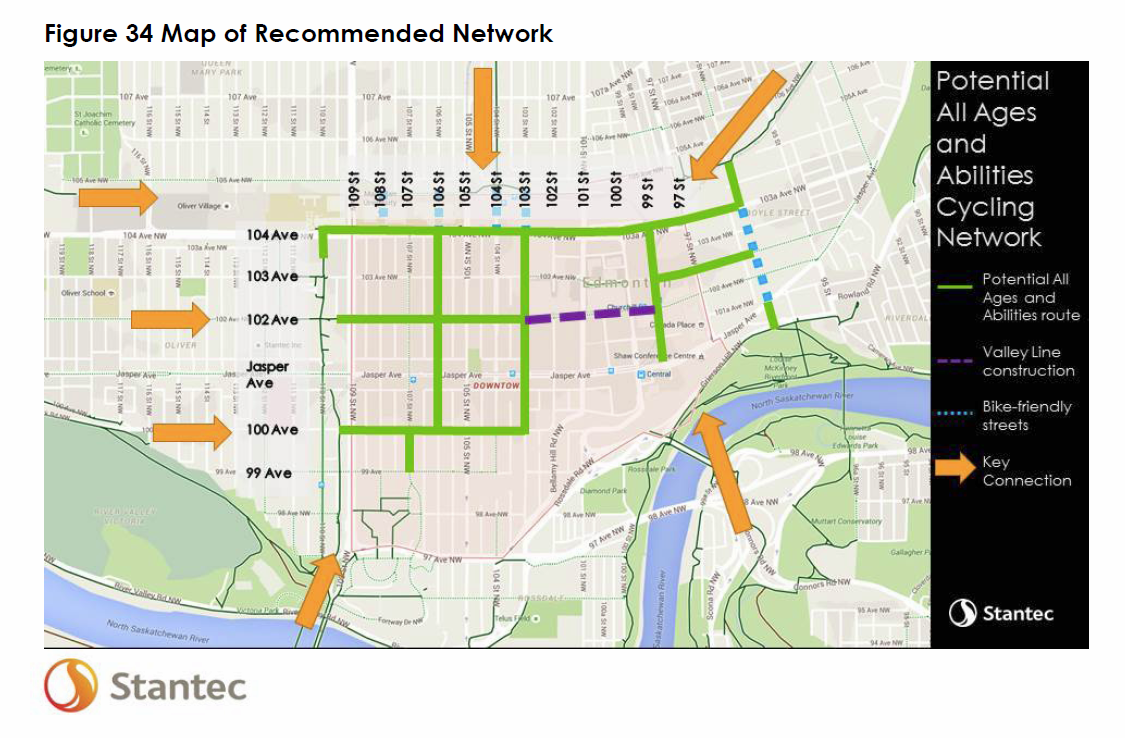
The report describes a 7.1km network of protected bike lanes, separated from traffic, in downtown Edmonton, connecting a grid of north-south and east-west routes to shared-use paths surrounding downtown. The entire report is 55 pages long, but we have summarized it here for you.
If it receives support at the Urban Planning Committee, the report will go to all of city council on October 11 for a decision on funding and timing. One the two funding options presented would see the downtown bike grid opening as early as summer 2017. But council needs to hear from you.
I am writing in support of a grid of protected bike lanes in downtown to be built spring 2017.
I would like to see your vote in favour on October 11, 2016.
Thank you,
Your citizen from Ward #
They need to hear your voice to understand how important and urgent this is.
We need organizations and employers too!
Does your workplace care about employee health, limited parking stalls, or the environment? Are you involved with an organization that is active downtown? If you host events downtown, or are connected to a downtown school, or businesses big and small, please talk to your organization or workplace about writing a letter of support for a downtown bike grid. This network will help ease parking concerns, improve employee satisfaction, and can increase attendance/sales.
Downtown Bike Grid
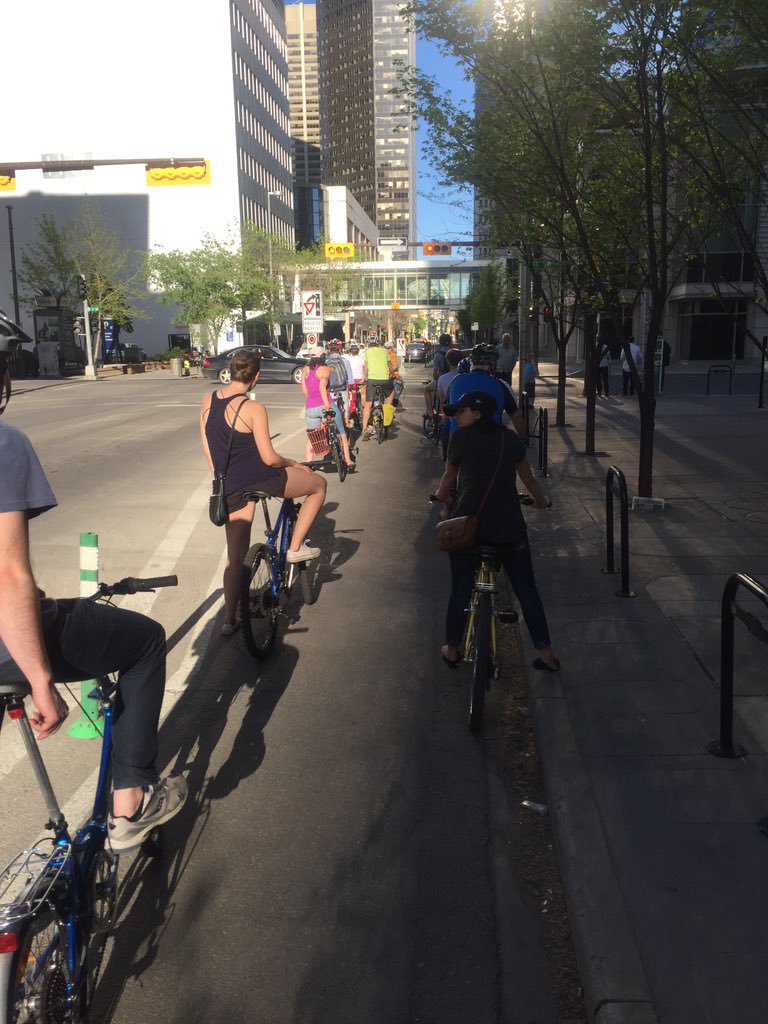
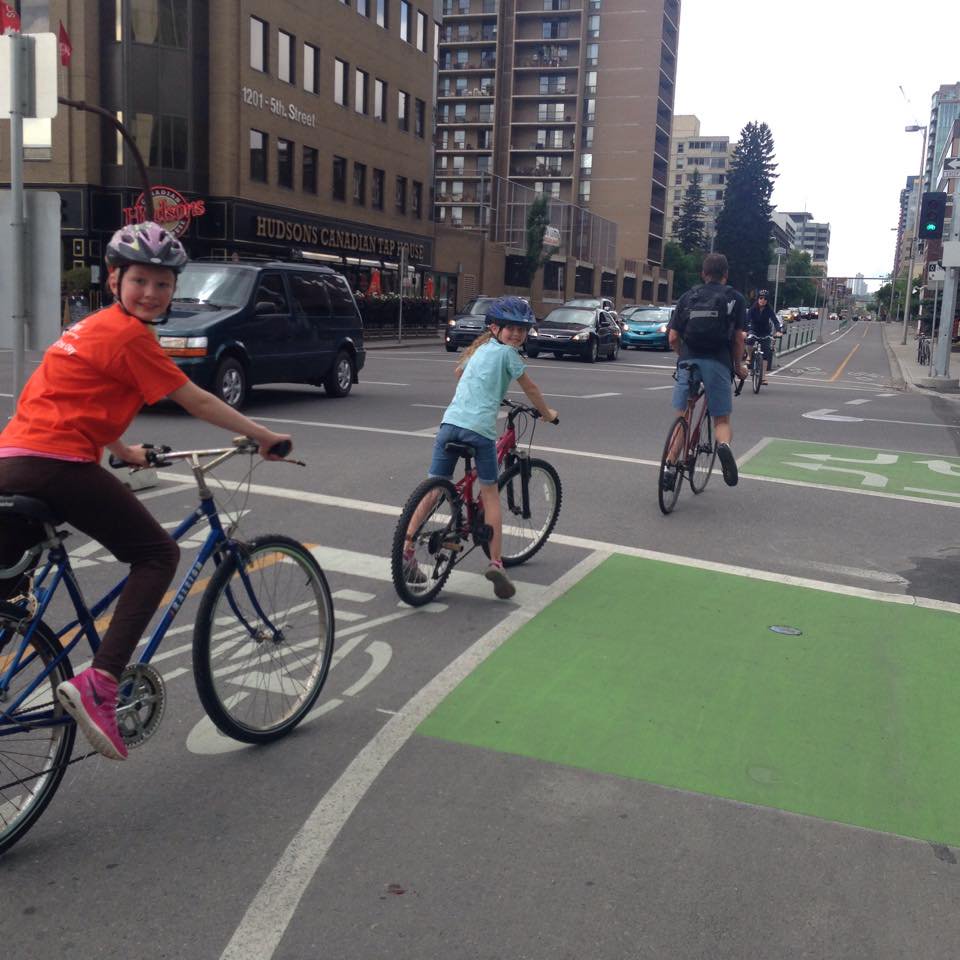
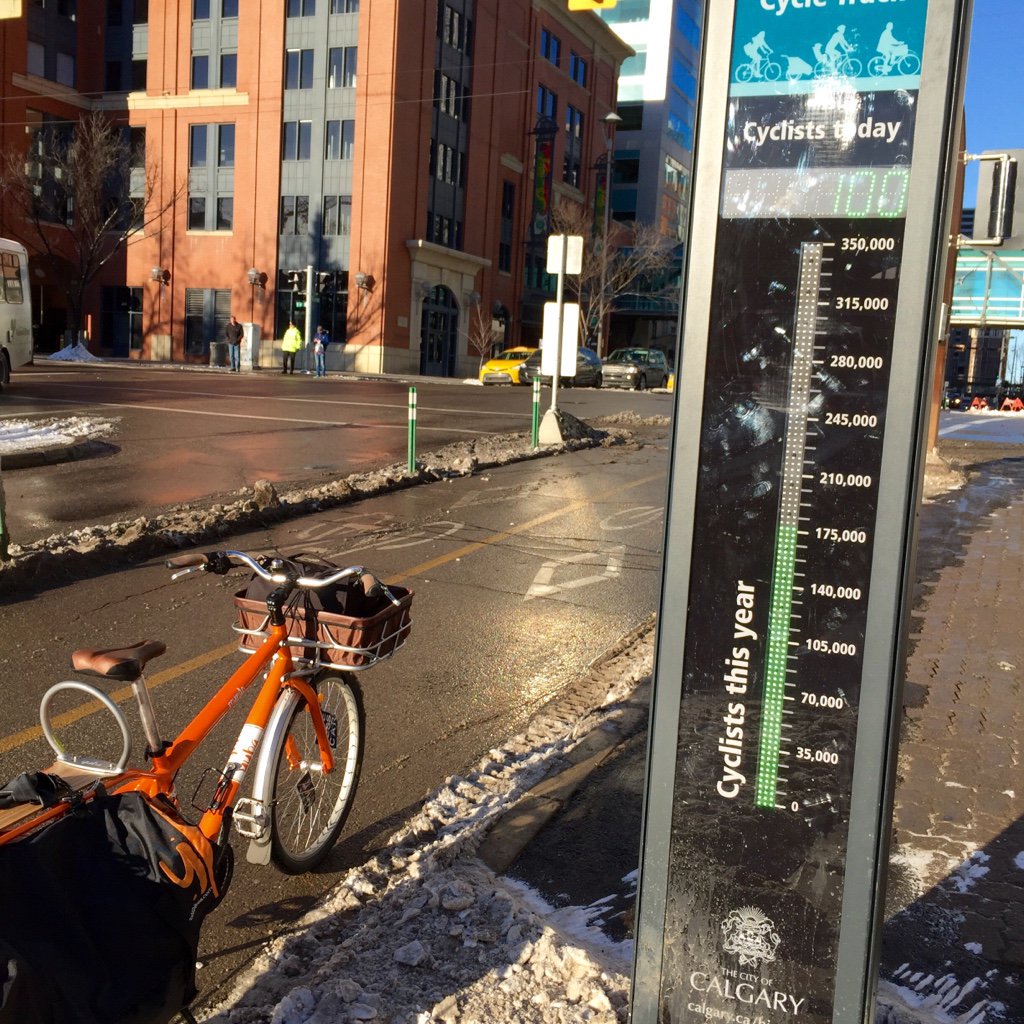
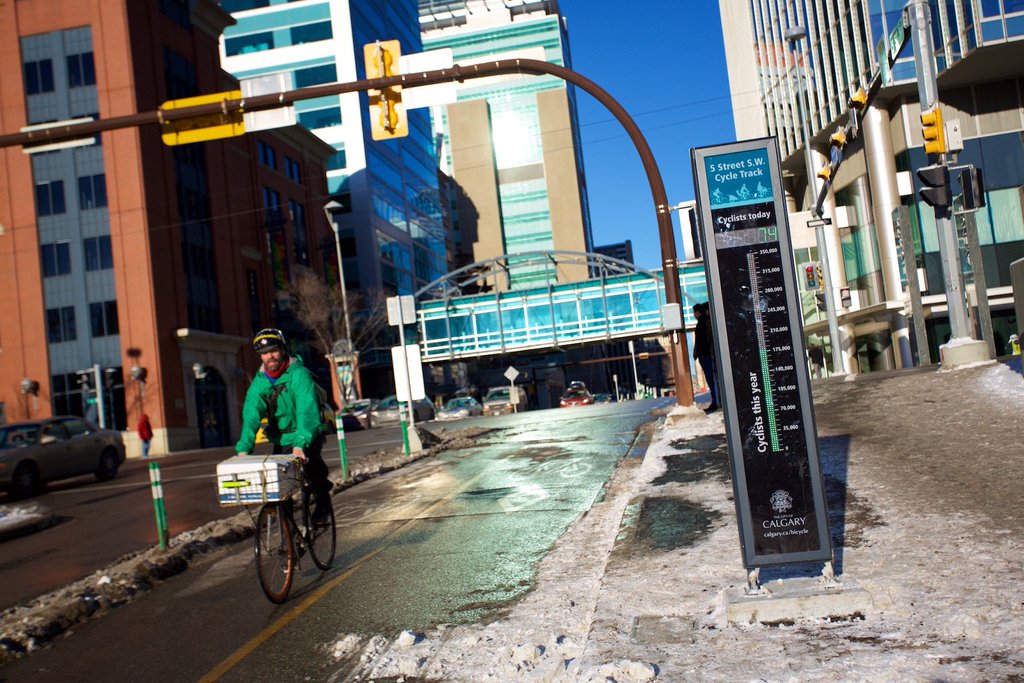
Calgary built a 6.5km downtown grid of protected bike lanes, also called cycle tracks, in 2015. It was given the same budget as proposed for Edmonton's ($7.5 million), but came in under budget and was built for only $5.7 million. Hugely successful, the network led to a 95% increase in weekday bike trips in the months after opening, and celebrated over 1,000,000 cycle trips across its three main embedded counters about a year after opening. (Its 10 automated counters tallied nearly a million trips in the first 6 months.)
Will it feel safe?
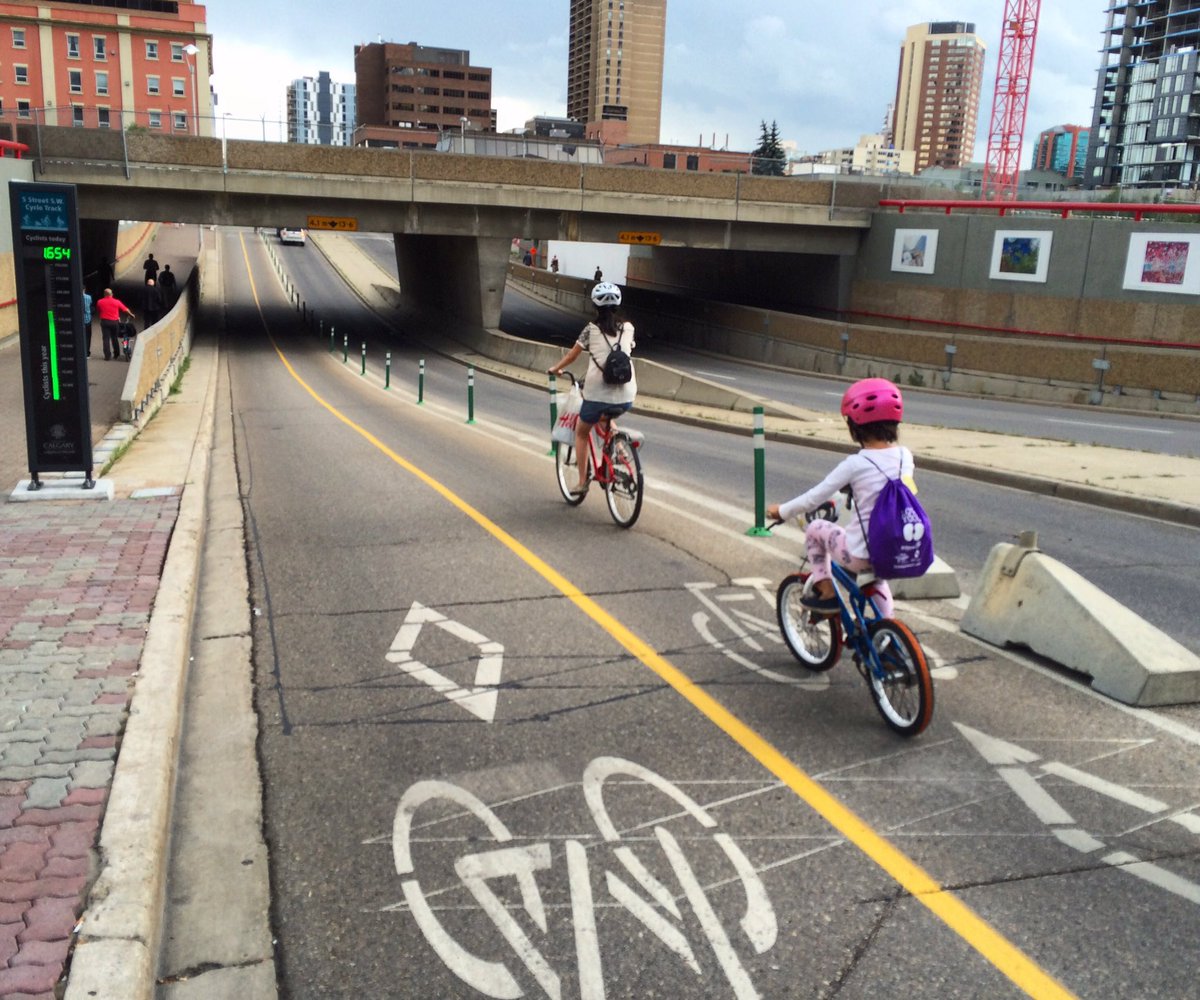
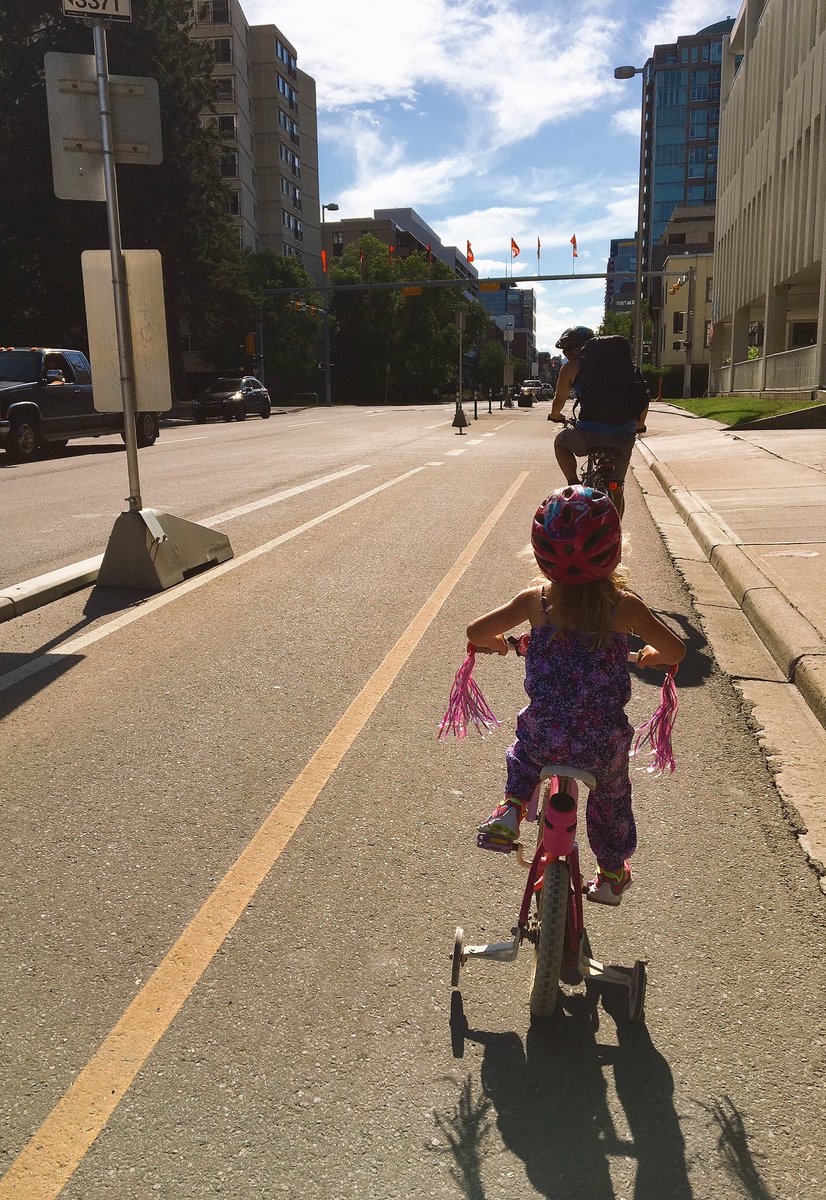
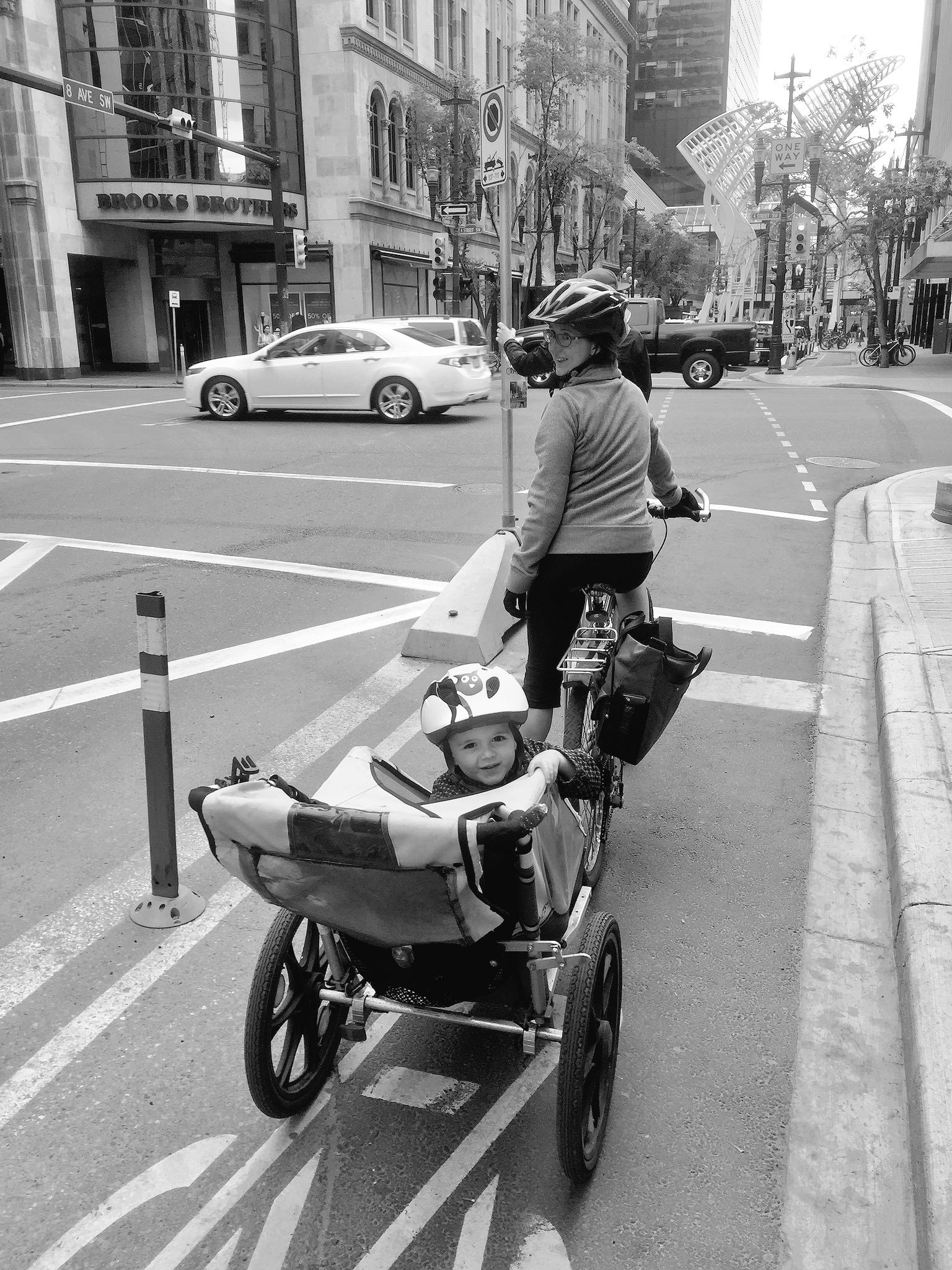
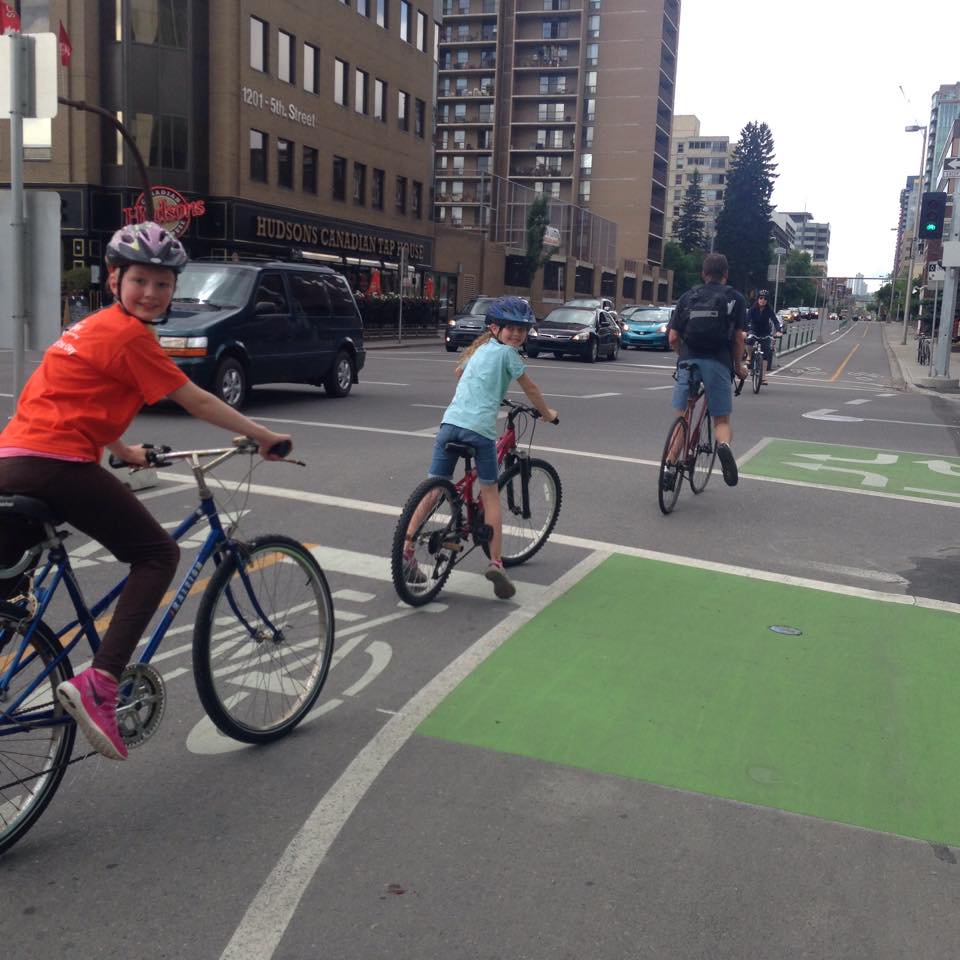
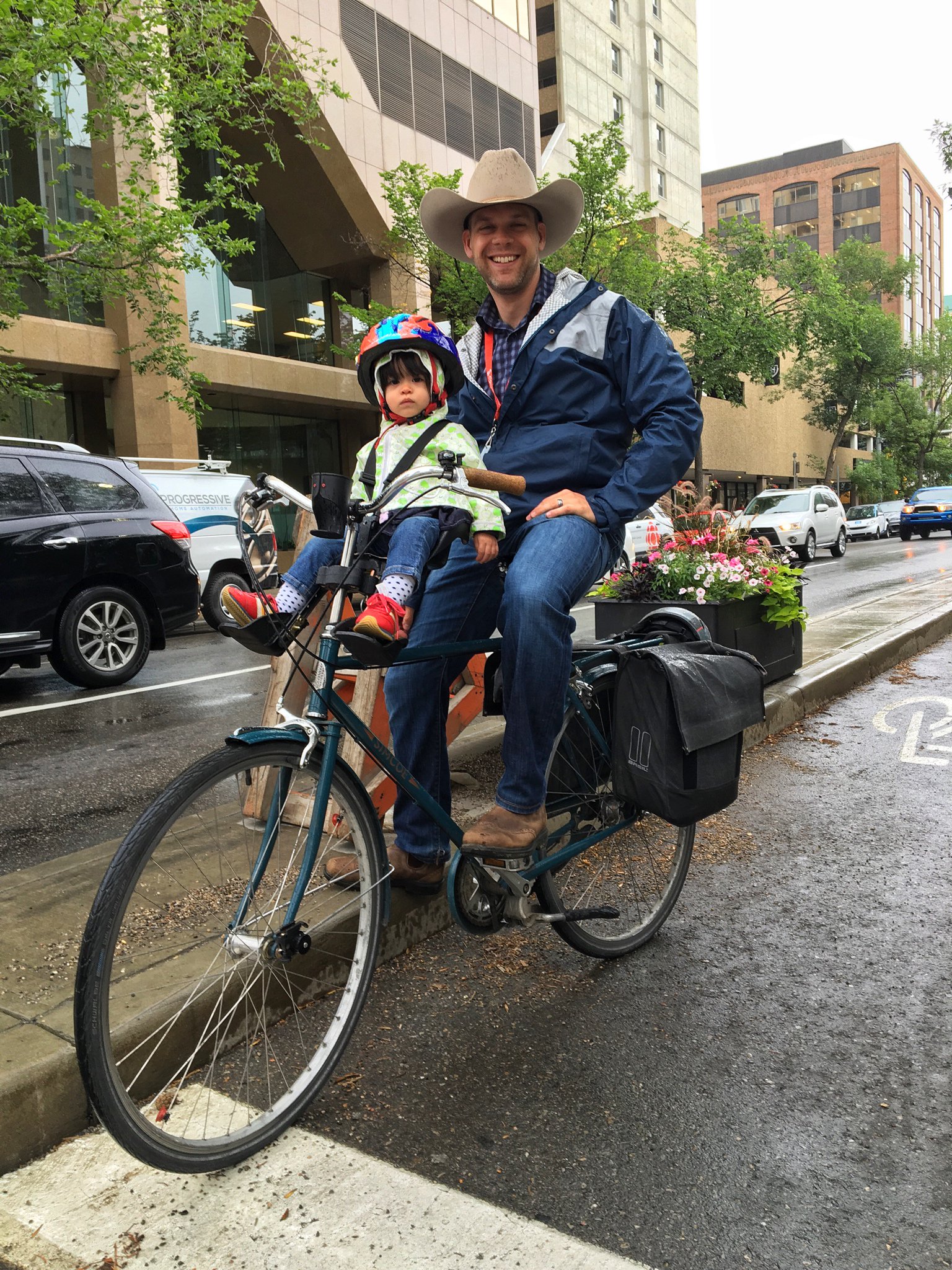
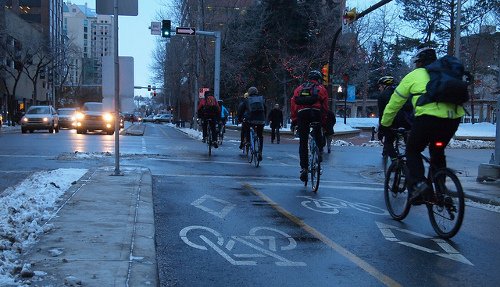
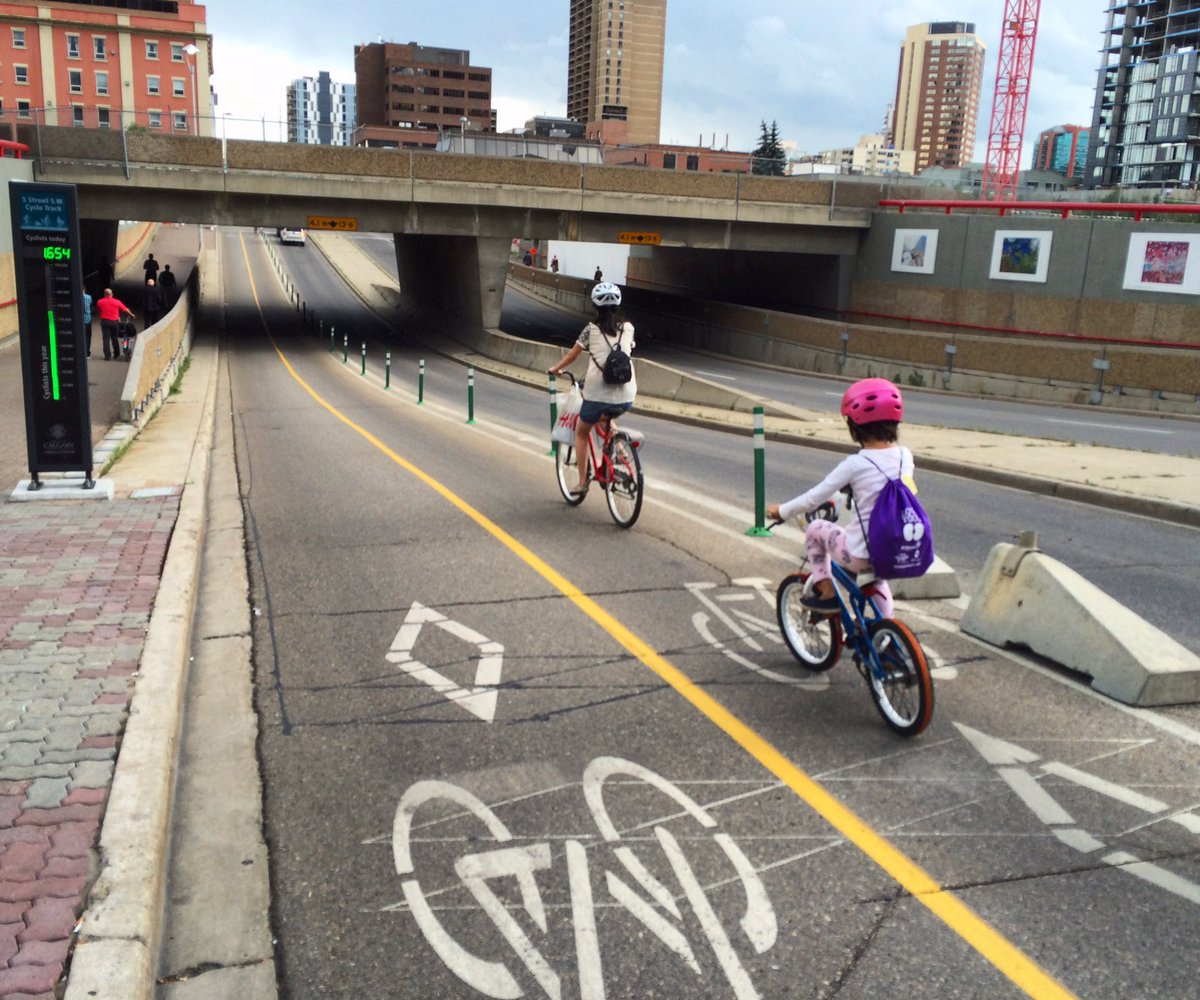
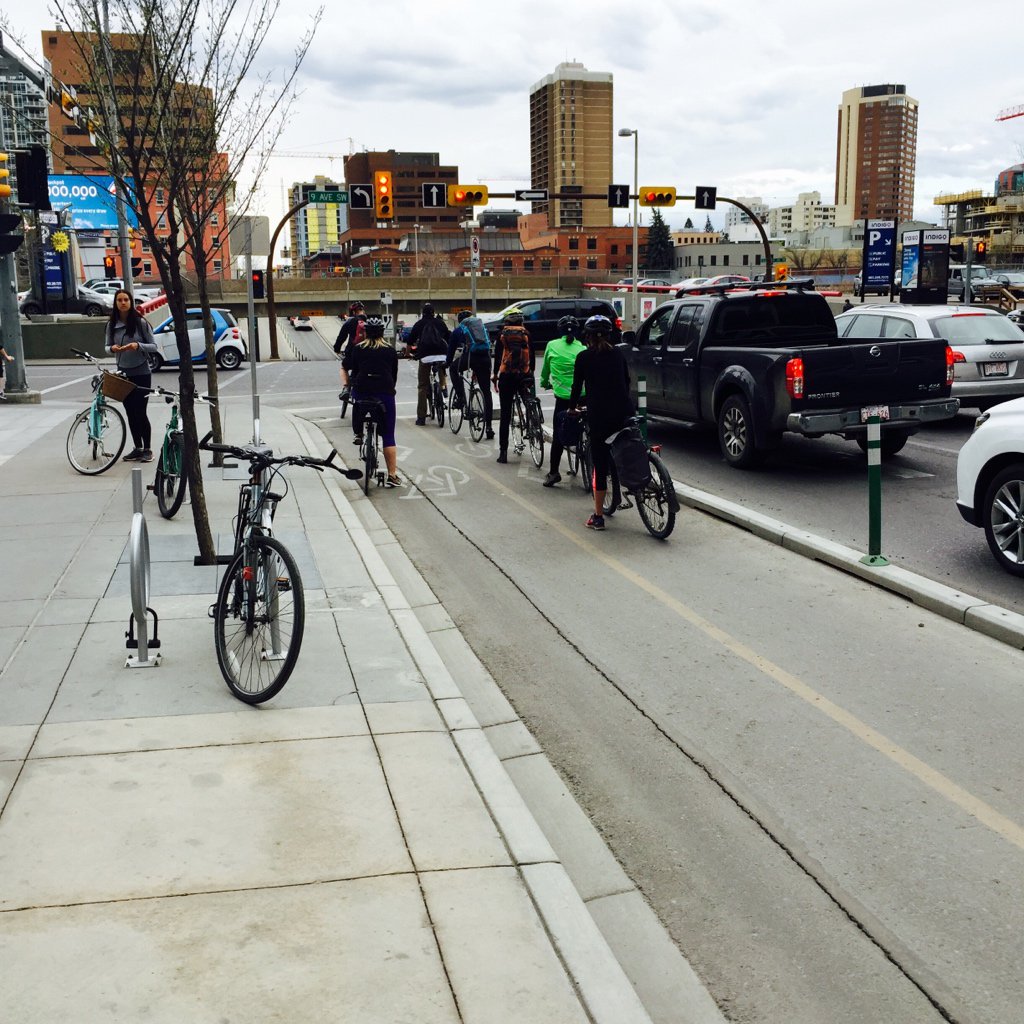
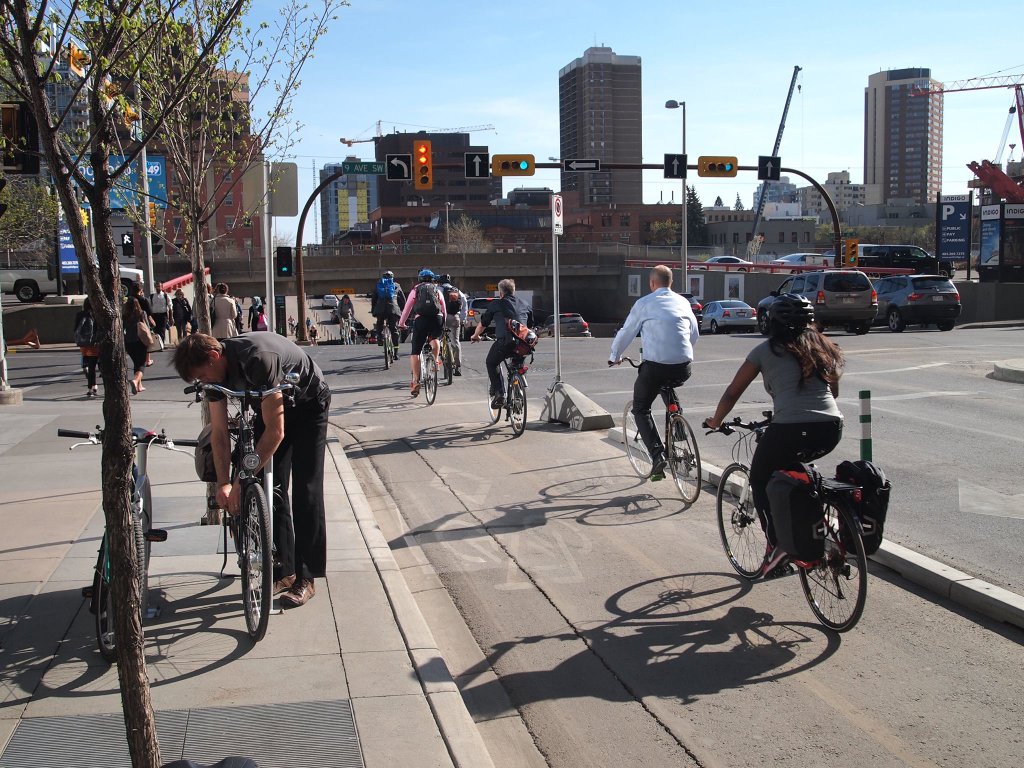
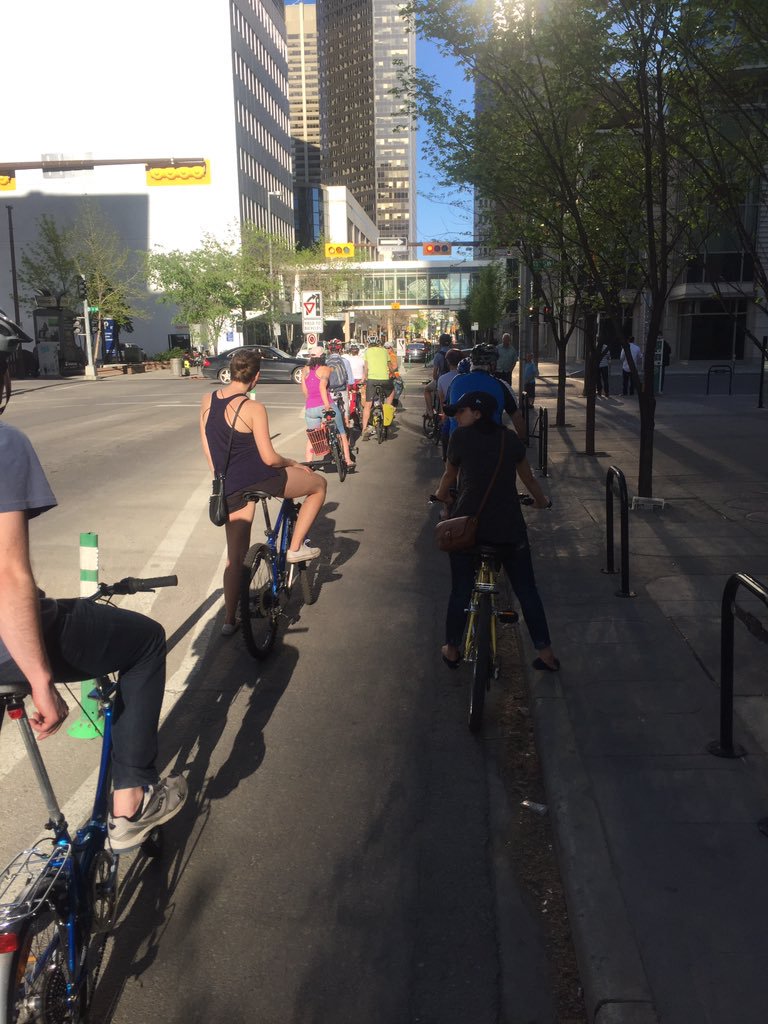
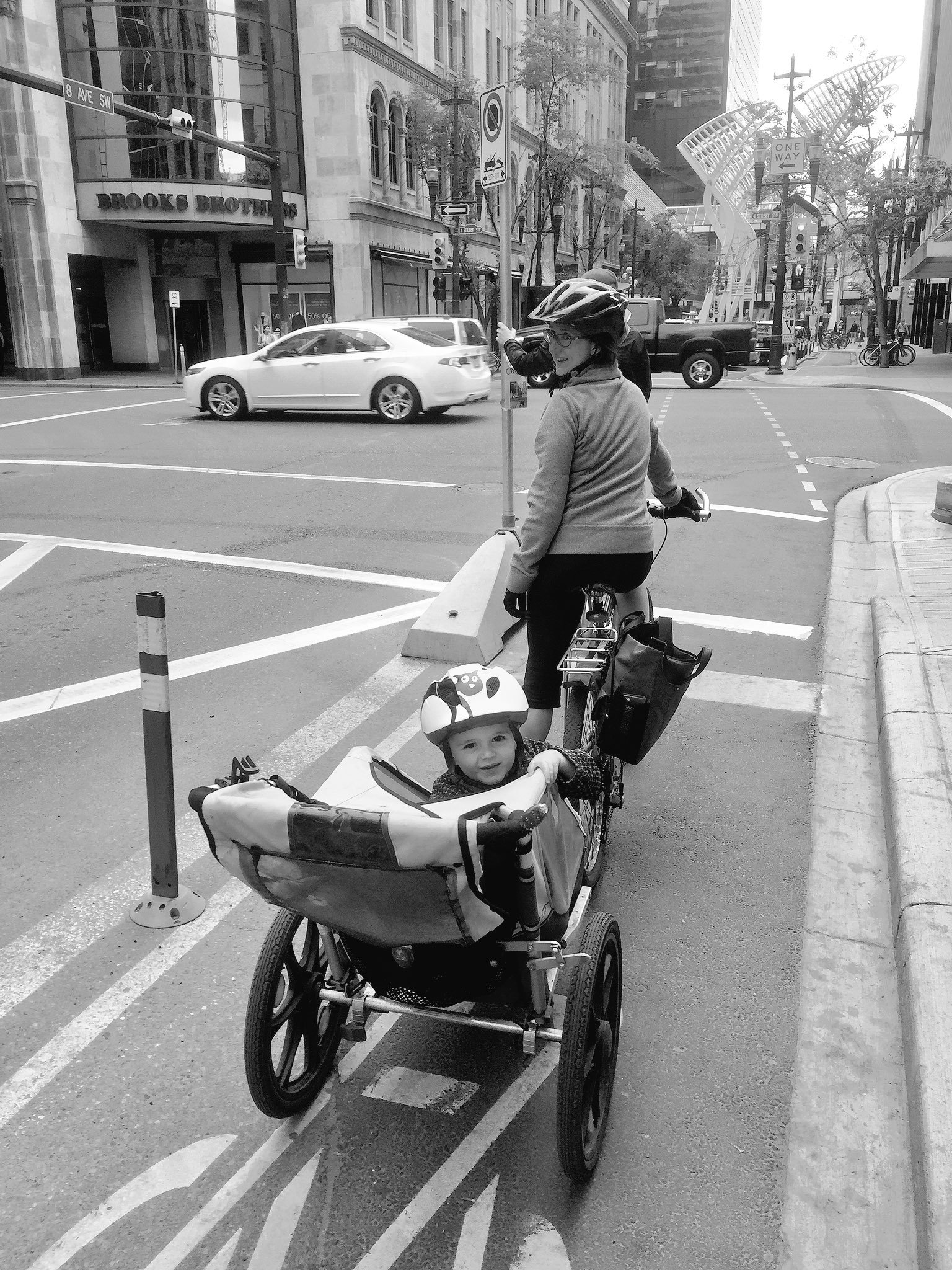
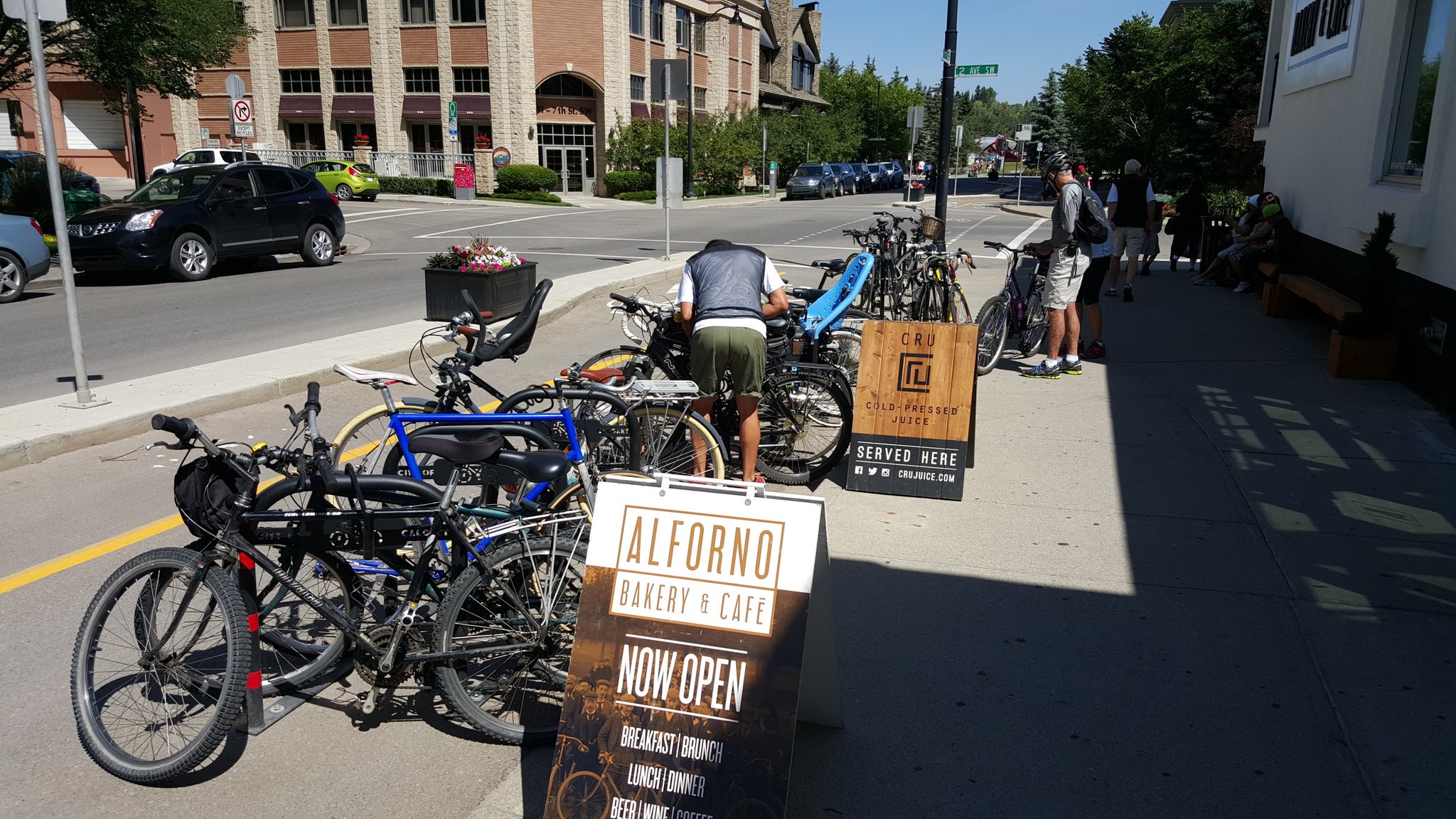
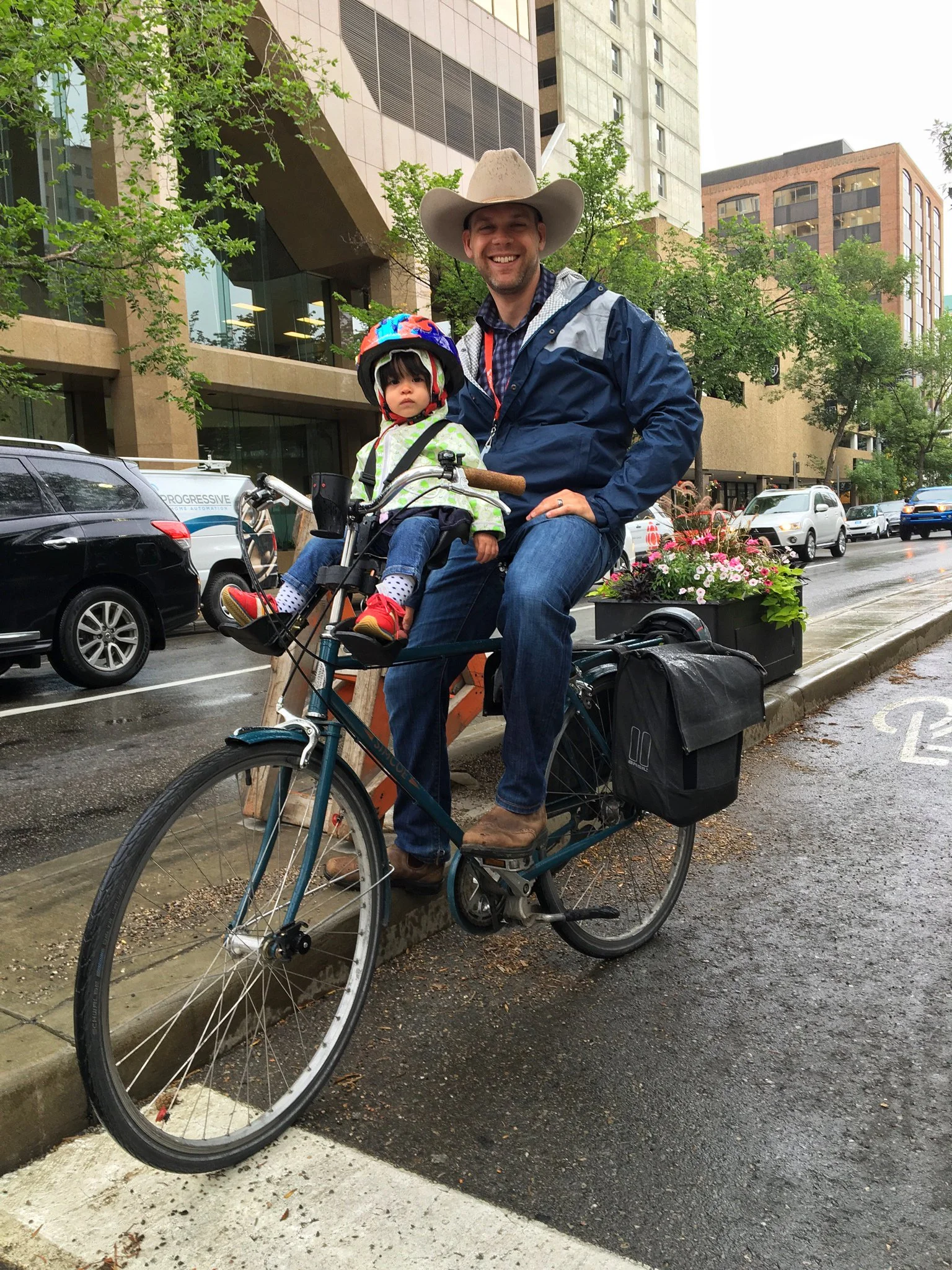
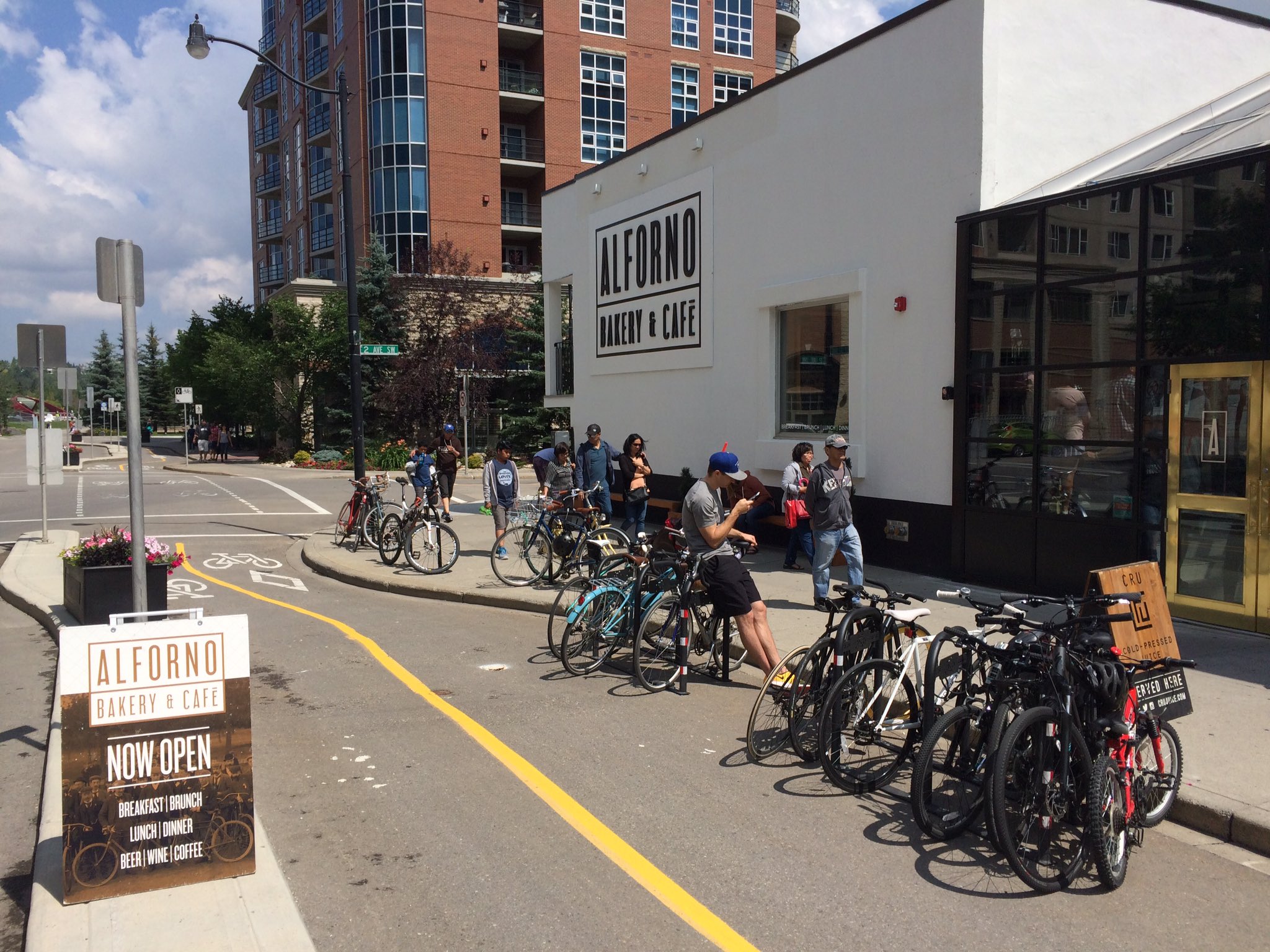
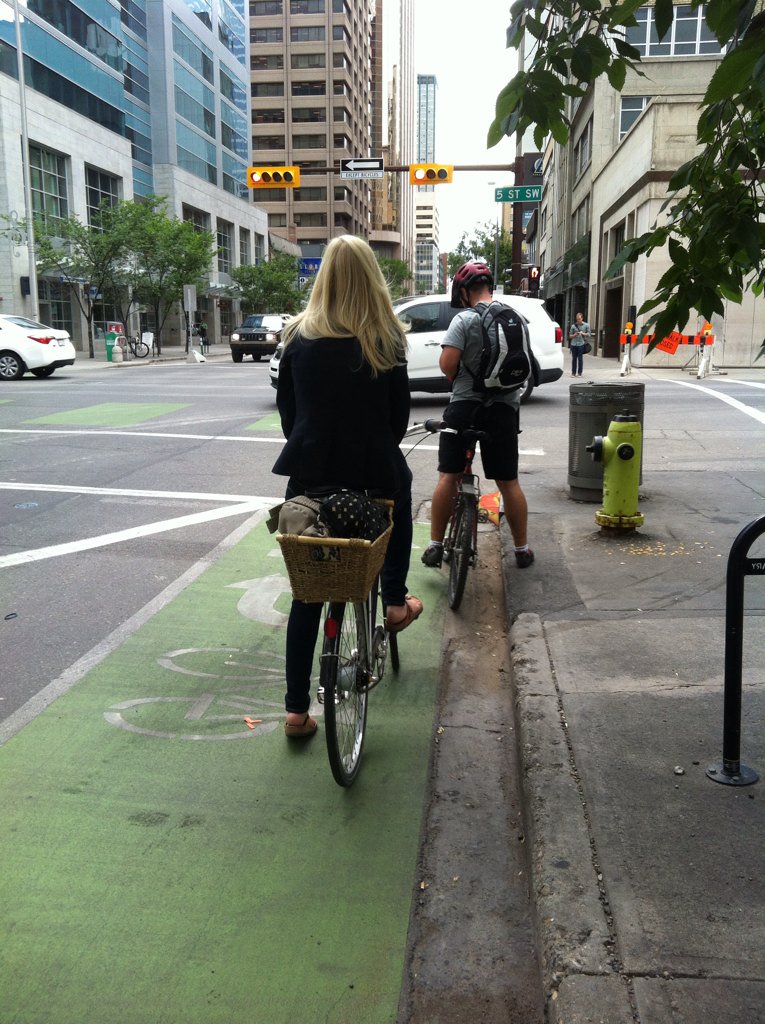
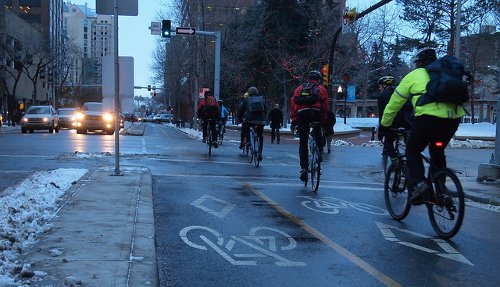
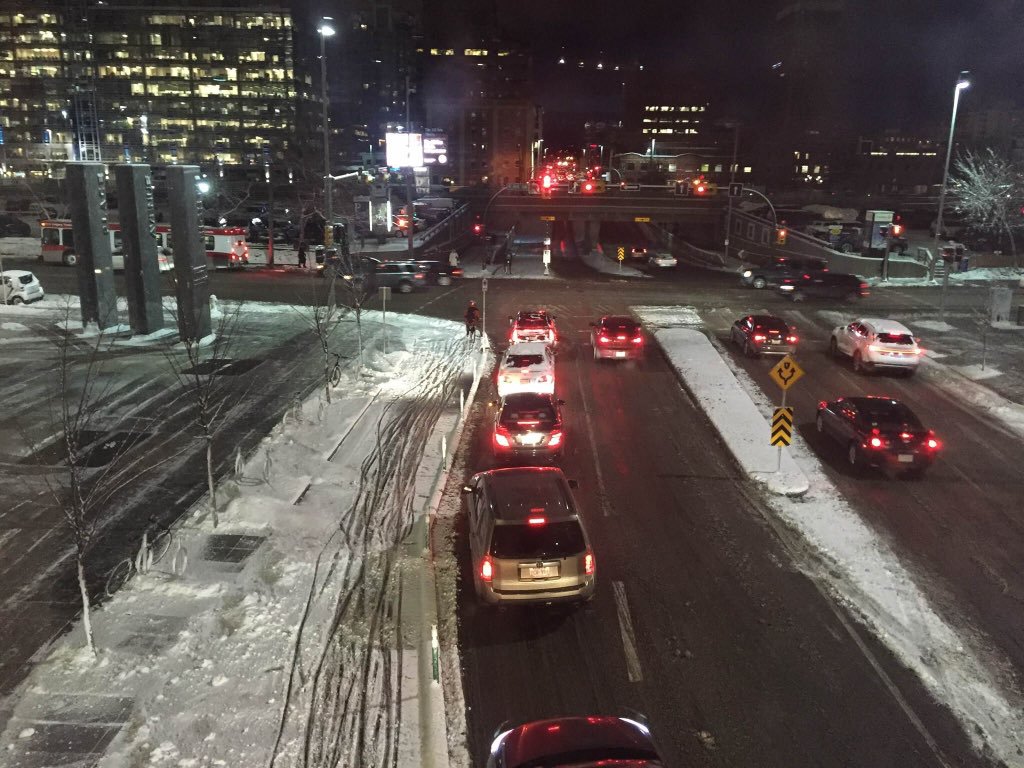
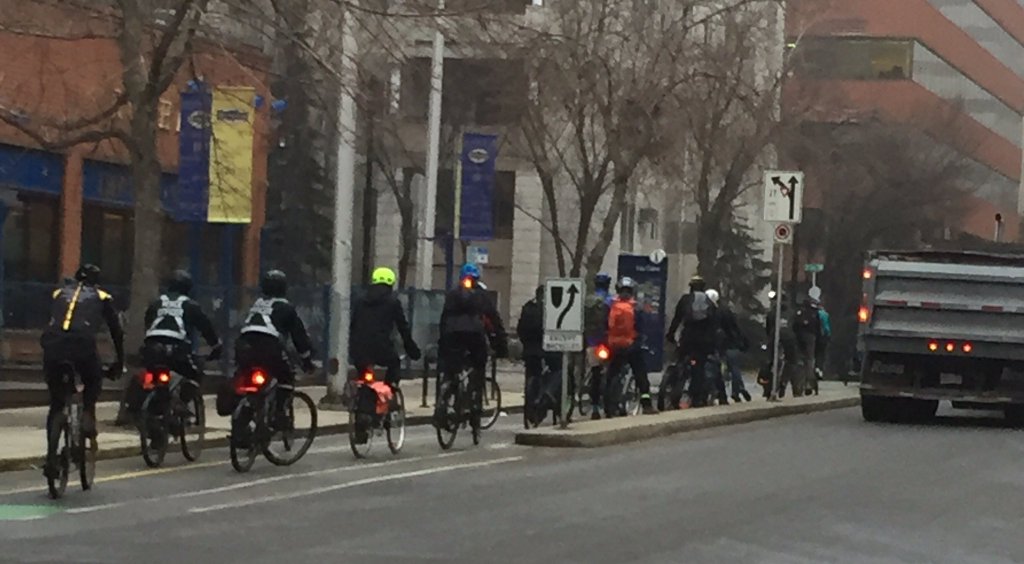
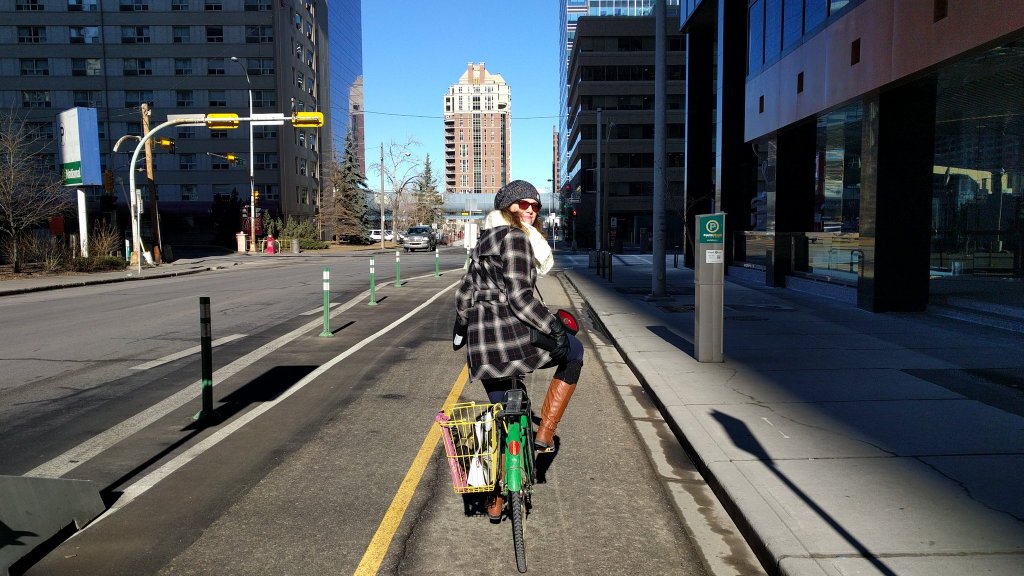
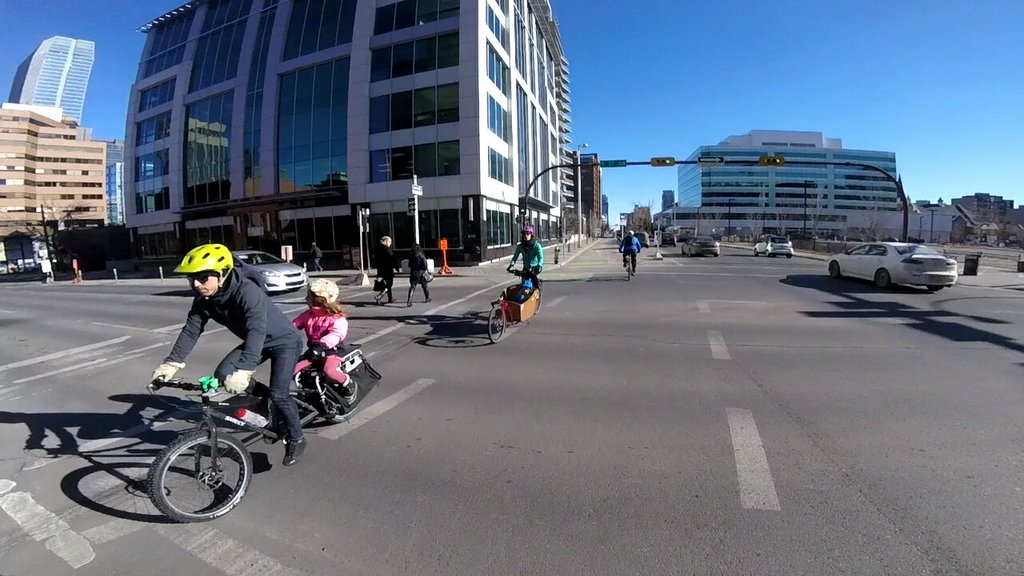
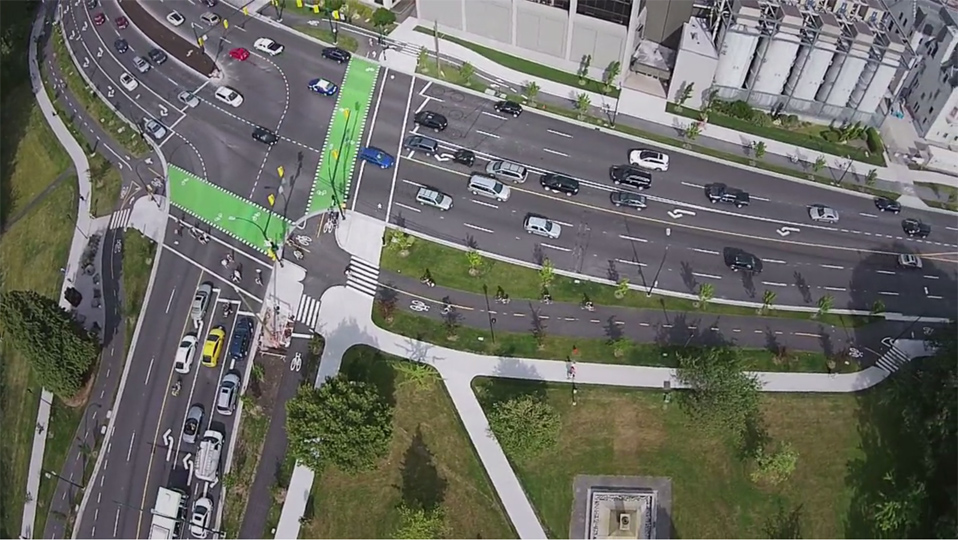
Here are videos and images of Calgary's cycle tracks, which Stantec also helped design. Based on their experience, Edmonton's will be similar, with improvements based on lessons from Calgary.
The implementation is flexible. If adjustments need to be made with this design, they can be made quickly. Calgary has made dozens of adjustments to its cycle track network based on feedback from users, drivers, and businesses. Calgary already made adjustments as early as the first initial weeks of operation.
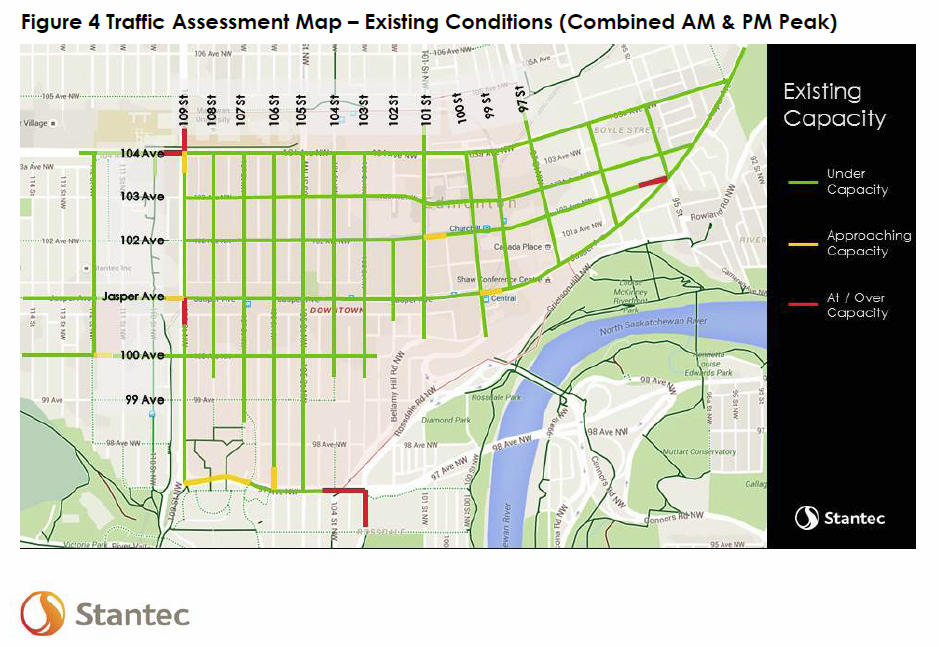
The report assessed existing capacity during AM/PM peak traffic conditions. Most roads are under capacity; those that were at capacity were removed from consideration. The analysis indicates that the bike lanes will not have a great impact on traffic. Calgary was much more constrained, but saw only limited impacts on travel time for drivers.
The selected routes connect to almost all the major existing bike routes leading into downtown, including 100 Ave, 102 Ave, the High Level Bridge/Railtown, 105 Ave, the Capital Line LRT shared use path, the Metro Line LRT shared use path, Grierson Hill shared use path, and the river valley.
The report addresses transit interactions (they're minimal on most of the selected routes) as well as maintaining access through downtown construction.
Maintaining on-street parking was prioritized in the route selection and design. Most of the routes maintain existing on-street parking; a couple routes maintain parking on only one side for some sections. Downtown Edmonton has an abundant supply of on-street and off-street parking, including an increased supply as previously private parkades are in the process of opening access in anticipation of demands from the arena.
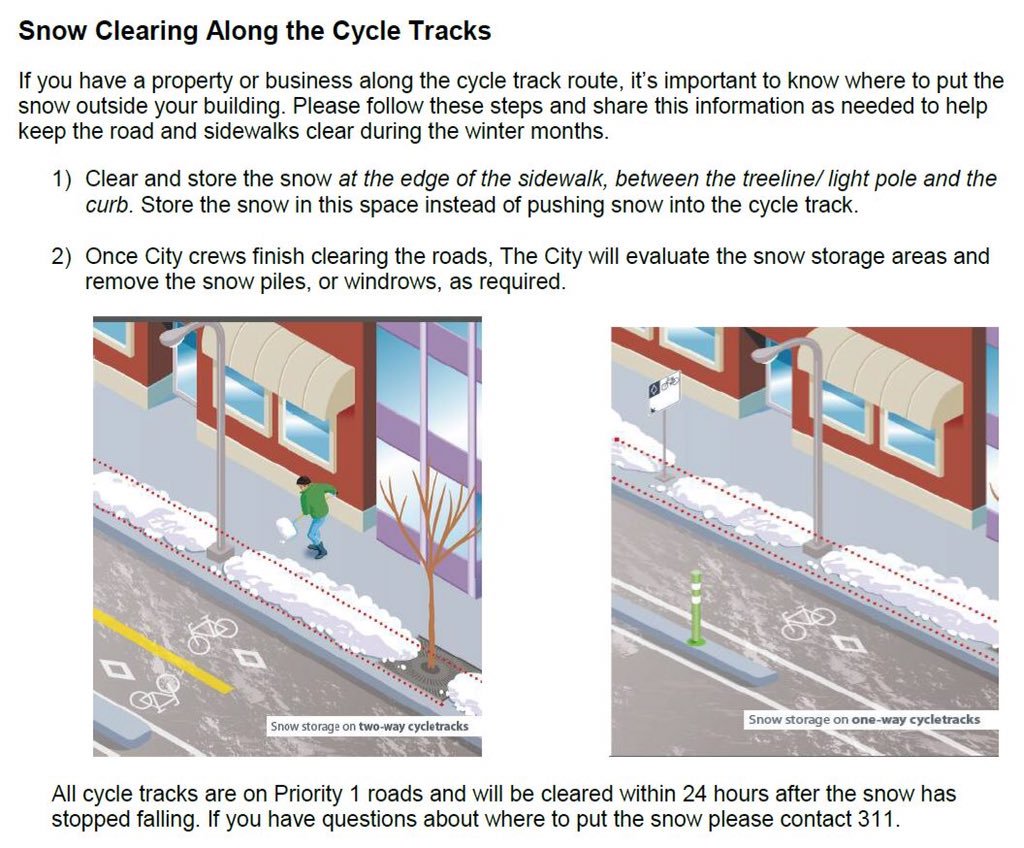
The recommended barrier design includes self-watering planters for flowers, and a concrete base to better limit snow, slush and gravel from migrating into the bike lane. The report includes $625,000 annually for operating costs, including snow clearing at the same priority as the rest of the road (for downtown, this means within 24 hours of the end of snowfall).
Over half of the capital costs are for upgrading intersections. Most of the intersection costs will go towards non-bike specific improvements such as replacing aging traffic controllers. The entire capital cost of the network will be paid using existing funds: no new funds need be allocated for the $7.5 million cost. Budgets are already allocated for traffic controller upgrades, a 102 Ave protected bike lane, complete streets, and active transportation. This downtown bike grid just gives a focus for those budgets.
The 104 Ave section will be a shared use path on the north side of the road.
You can review the full report to see detailed assessments, including road surface conditions, parking impacts, and the proposed design of each route.
A few things not fully covered in this report include:
Clear connections to the new funicular at 100 St and MacDonald Dr
A protected bike route connecting 107 St down Fortway Dr (behind the Legislature) to River Valley Road
Protected lanes along 100 Ave west of 110 St to the 121 St bike lane
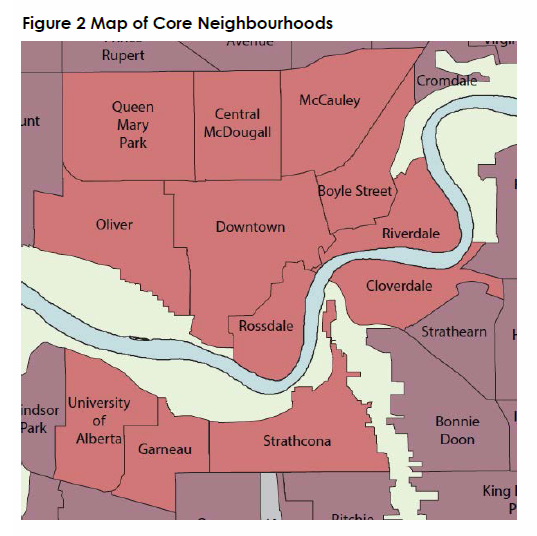
Discussion of the south side of the river (University, Garneau, Old Strathcona). The original motion from council included a request to consider these areas as well, but due to time and funding constraints the scope of this report is limited to downtown.
Why a downtown bike grid?
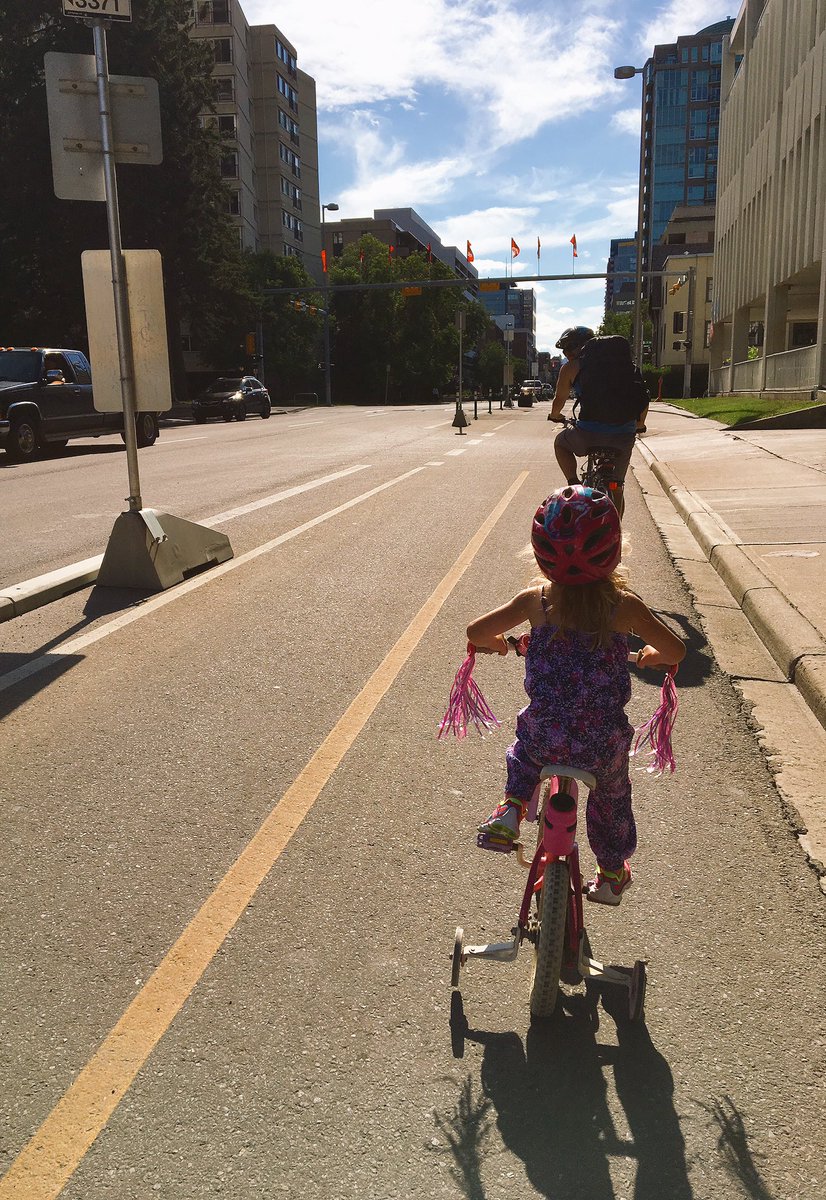
It works. Calgary's city-wide cycling mode share has doubled since 2011. People feel safe enough to ride with young children; even to teach their children to ride. Separated bike lanes reduce the risk of collision by 90%.
Good bike infrastructure dramatically reduces sidewalk cycling.
Edmonton's lack of infrastructure doesn't work: at least 19 cyclists/year are injured within a 5 block radius of the downtown core. Many more incidents of harassment and collisions go unreported.
Public health: increased physical activity is one of the best ways to improve individual health and creates massive public health benefits, and therefore cost savings.
The selected routes are on roads with excess capacity. That capacity can be more equitably distributed.
A single lane is not very useful; a network is essential. This network passes near to all downtown destinations, and connects well to other heavily-used routes.
More people biking means less wear and tear on the roads, fewer potholes, less congestion, and more available and cheaper parking.
This is city building (and about as cheap as you can get it). It enhances the public realm, increasing vibrancy in Edmonton's downtown.
There is significant latent demand for cycling infrastructure that's safe for ages 8 to 80. Downtown has high existing and higher future concentration of people, jobs, and destinations, but due to high traffic volumes and lack of safe infrastructure, the majority of people don't currently feel comfortable biking downtown, even though the majority of Edmontonians are interested in cycling.
The current allocation of our roadways is inequitable. We all pay for the roadways through our property taxes. People shouldn't be treated as second-class citizens simply because of their mode of transportation on any given day. The average Edmonton household spends over $11,068 each year on transportation. The median household income in downtown Edmonton was $35,858: almost 31% of the household income went to transportation.
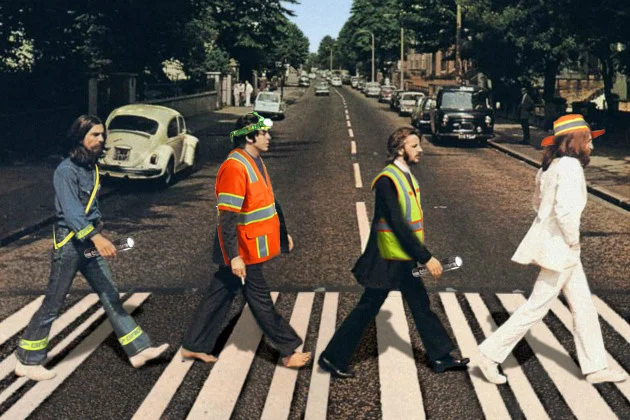
When you step out of your car, do you immediately don your safety vest? When you step out of the office after work, do you flick on the flashlight that you always carry with you?
Are you properly equipped to cross the road?
According to the City of Edmonton's latest "traffic safety" campaign:
"wearing a strip of reflective material or a reflector can save your life."
"pedestrians always come out the losers"
"If you are lucky, it will only bump you."
visionzero-pedestrian-insight
Zero Vision
Under the banner of Vision Zero, Edmonton's "Heads Up" campaign firmly offloads responsibility for pedestrian injuries and fatalities from the City's poor road designs and dangerous speeds and onto pedestrians themselves.
This is the antithesis of Vision Zero.
Give the City your feedback
The City is conducting a survey that includes a question about this ad campaign. You can give your feedback until noon, Tuesday, September 20.
Vision Zero is the Swedish approach to road safety thinking. It can be summarized in one sentence: No loss of life is acceptable.
The core principle of the Vision Zero concept is that in every situation that a person might fail, the road system should not.
Vision Zero accepts that humans will make errors, so the system must account for that. Typical roadway design has focused on maximizing capacity, and then assigning blame to users when incidents occurred. But with Vision Zero design, the entire system is focused on increasing safety at every turn, so the system takes leadership in preventing scenarios where user error could cause injury.
visionzerocanda-tweet
The City's responsibility in Vision Zero is to use its limited resources as efficiently as possible to make the roads safer. It can do this by designing better roads, improving pedestrian connectivity, and improving dangerous intersections. An ad campaign that misdirects responsibility and implies that pedestrians (even those wearing yellow or orange!) are "lucky" to only be "bumped" by cars does not improve safety.
Point, look & cross: Edmonton aims to be the Fashion Capital of Western Canada
To be clear: we know very well that as a driver, it can be difficult to see unlit pedestrians or bikes at night. We have hosted workshops on making retroreflective clothing, and making your own bike lights. We sell hundreds of bike lights, starting at $1.49, at both of our volunteer-run, non-profit community bike shops, BikeWorks North and South.
But the City of Edmonton is in a position to do much more than just admonish people to dress shiny: their focus here is misguided. Even if they truly felt that this was the best focus for their resources, they would likely be better served by spending the same money to hand out lights and reflective bands at busy trails and intersections.
But it's likely not the best bang for our buck: a New Zealand study of car-bike collisions found that "the most physically conspicuous group had a higher risk [of collision involving a motor vehicle] in Auckland", i.e. those that wore high-visibility clothing and reflective gear were actually more likely to be hit by a car. A study of Calgary and Edmonton found that "the risk of collisions with a motor vehicle was increased by wearing fluorescent clothing", even after adjusting for commuting and bicycling location.
In Edmonton in 2015, 225 (68%) pedestrians were injured or killed while crossing with the right of way. Only 57 were crossing without the right of way. The majority of pedestrian collisions occurred during regular work hours, between 8am and 6pm. 40% of fatally injured pedestrians have been drinking; before you drunkenly stumble out of the hockey game, will you always don your safety vest and contemplate the anti-jaywalking billboard you saw earlier in the day?
What is the problem, and what are the solutions?
The problem is the City placing lights that illuminate only the road but not the sidewalk. The problem is the City poorly lighting or poorly marking crosswalks. The problem is the City creating long stretches of road without marked pedestrian crossings, encouraging pedestrians (especially those with small children or mobility challenges) to cross without a marked crosswalk. The problem is the City designing road networks that don't have strong pedestrian connectivity, forcing pedestrians to walk along either busy arterial roads or dark, unpopulated trails. The problem is the City designing roads for more cars to move faster and faster without having to worry about slowing or stopping, and then using long signal timings or other anti-pedestrian measures to deter walking.
The problem is the City continuing to unfairly direct blame onto pedestrians rather than taking responsibility.
Don't stop speedin' Hold on to that feelin' Pedestrian people Won't be interferin'
Imploring anyone on foot to arm themselves with personal protective equipment in case they get "unlucky" is not a solution.
It is a signal of the City's failure to protect its citizens and to provide them with safe, healthy options to move about their neighbourhoods and their city.
Notice is hereby given to all EBC members that there is intention to propose the following resolution to be passed as a special resolution during the EBC Annual General Meeting on October 2, 2016.
WHEREAS the Board of Directors of the Edmonton Bicycle Commuters Society recommends amendments to the Society's Bylaws;
THEREFORE BE IT RESOLVED that the Bylaws be amended as follows:
4(a) "The Board is required to hold a meeting, which shall be chaired by an Interim Chair who shall be an outgoing Board member or a member at large, within one calendar month of the AGM. The date for this meeting must be set at the AGM. At this meeting, the Board shall elect a President, Vice President, Secretary, and Treasurer. No person who has held any combination of these positions during each of the previous four years shall be eligible to hold any of these positions for a fifth consecutive year. The Duties of the Interim Chair shall terminate on completion of the election of officers."
4(a) The Board is required to hold a meeting, which shall be chaired by an Interim Chair who shall be an outgoing Board member or a member at large, within one calendar month of the AGM. The date for this meeting must be set at the AGM. At this meeting, the Board shall elect a President, Vice President, Secretary, and Treasurer. The Duties of the Interim Chair shall terminate on completion of the election of officers.
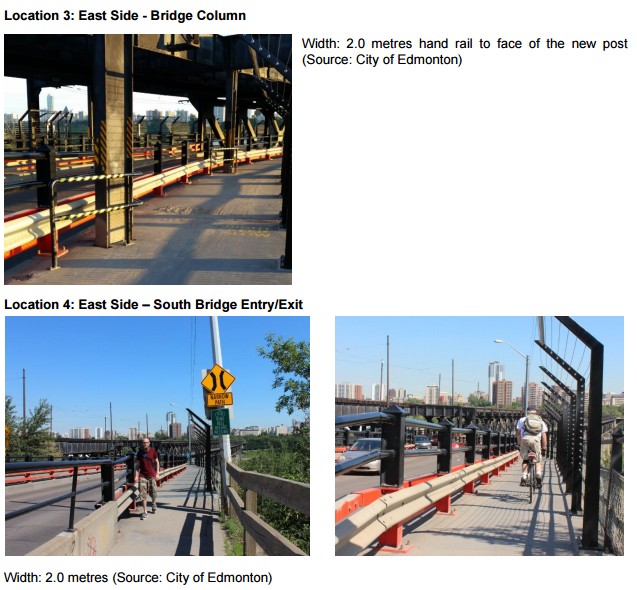
A safety audit of the operation of the High Level Bridge for walking and cycling has just been released. You can view the full report online. There are many good recommendations in this safety report, including:
enhancing the barriers between the roadway and the paths (ideally in a way that minimizes splashing from cars, ice build-up, and wind), both on the bridge itself and some of the approaches,
better marking hazards,
removing barriers such as signs and posts and some redundant fencing,
fixing uneven surfaces,
installing rub rails,
improving lighting,
widening the approaches and improving sightlines at intersections
One-way operation is not supported
One recommendation that we do not support at this time, however, is the safety audit's recommendation to make any of the paths one-way.
Edmonton claims it wishes to promote active transportation. Placing further barriers to active transportation belies this claim.
Mandated one-way operation would further reduce capacity on the High Level Bridge: a problem now, and in the future if we wish to encourage more people to walk and bike. It would also make the bridge much more difficult to use, requiring long and dangerous traverses.
Have you seen trucks, trailers, or buses rolling over this curb at 109 St and Saskatchewan Drive? Let us know.
The City should be looking at solutions that improve the conditions, not jump to rash, anti-solutions that address one problem by making conditions worse.
First, the City should monitor usage and safety issues on the bridge, comparing them to statistics from before the suicide barriers were erected.
We collected many self-reported anecdotes, mostly when all traffic was routed to the east side. These are not scientific numbers. The City needs to collect robust numbers and compare them to pre-barrier baselines. Now that both sides of the bridge are open again, if the injury rate hasn't changed significantly from before the barriers were installed, is there really urgency to change the operation of the bridge?
If the City is able to collect data demonstrating that there continues to be an unacceptably high injury rate, and urgent changes are needed, we may be supportive of limited one-way operation, but only as a near-term mitigation method in conjunction with other changes, potentially with narrowly-defined hours and direction (e.g. east side operates as northbound in the AM peak, southbound in the afternoon peak, and unrestricted otherwise).
Improve intersections, irrespective of other changes
One change that should happen before any changes to travel direction on the bridge is improvements to crossings at both the north and south ends of the bridge. At the least, without any dramatic or expensive infrastructure changes, light signal timings could be altered to allow pedestrians and cyclists to cross the intersection in one phase, rather than multiple phases. There already exists a phase on the south side when no pedestrians are allowed to cross in any direction. There could also be a phase where no cars are allowed to move in any direction, but pedestrians and cyclists could cross in every direction (and clear the intersection much more rapidly).
This improvement, which still falls far short of more substantial improvements to the intersections, would improve safety and recognize the 3500 daily pedestrian and cycling users as more than just interlopers, ducking between turning cars and taking refuge on narrow concrete islands.
Additionally, we know that one of the best ways to influence behaviour (and encourage "desireable" behaviour) is through design. Enforcing one-way operation of the High Level Bridge paths would be extremely difficult, at best, and even more challenging if the City simultaneously maintains the many barriers between the west and east sides. By improving the intersections and making them easier to traverse, many people would opt to use the west side of their own accord, reducing pressures on the east side (and possibly any potential need to make it one-way).
Committee Meeting
City administration's report to committee, which talks about "solutions to make the pathways more cyclist and pedestrian friendly," lists one-way operation under "further investigation" and clarifies that "prior to making any further changes to the current condition, Administration will continue to engage the public to review options to enhance the operation of the two sidewalks/shared-use paths."
The City hosted a meeting with over a dozen stakeholders in August to review the draft safety audit. The consensus in the room was that one-way operation was not currently an acceptable option.
Finally: the committee report lists metrics, targets and outcomes. We are disappointed that none of the metrics consider public health or user safety. We strongly support suicide prevention measures and stronger mental health supports for Edmontonians. Thit is not a mutually exclusive goal from increased active transportation: in fact, the two are complimentary. If additional barriers to active transportation results in fewer people choosing to walk or bike, or indeed in direct injuries, that information should be captured in the City's metrics.
Please consider volunteering for EBC's YCR2 on October 1st and 2nd - bike intake days! Both mechanics and non mechanics can help out. Here's a handy sign up sheet: Volunteersignup
You Can Ride 2 is an EBC program. Our main goal for this program is to loan out modified bicycles to children who would otherwise not be able to participate in cycling. We try to find the best bike for every kid! Sort of magic, really :)
Please attend our Annual General Meeting on October 2, 2016 from 1pm-3pm at the Downtown Edmonton Community League (10042 103 St NW). Everyone is welcome to attend!
Our President (Jonathan) and Treasurer (Geoff) will present their exciting reports of the board's activities this past year and the direction we're heading.
Our Executive Director (Chris) will present our Annual Report describing our programs, advocacy, and public events.
EBC members will vote on bylaw amendments and the 2016-2017 budget.
Finally, members willl vote in a few new Board of Directors. If you are interested in helping to set the direction of our organization and strengthen our current awesome governance, please consider joining the Board of Directors. Nominations can be submitted at http://edmontonbikes.ca/nominations
On Friday, August 26, 2016, join us at 5:30pm in front of Edmonton City Hall (Sir Winston Churchill Square) for a memorial ride in honour of Isaak Kornelsen. The ride will proceed slowly and in legal order to the Memorial Parklet for Isaak Kornelsen at 10151 82 Ave. This ride is both a celebration and remembrance of Isaak’s life, as well as a demonstration in support of dedicated, safe cycling infrastructure.
The destination memorial will take the form of a parklet, a small urban park set up temporarily in two metered parking spaces. The parklet will be a one day public space on Whyte Ave in honour of Isaak Kornelsen.
Isaak’s life was tragically cut short on August 27, 2012, at the age of 21 while cycling on Whyte Avenue. Isaak was a Strathcona High School valedictorian, University of Alberta Philosophy student, and runner for both the Golden Bears and Edmonton Thunder. But most importantly, he was a sincere and loving individual who brightened the lives of everyone he met.
The parklet is designed to symbolize various aspects of Isaak's life, and the ideals he upheld. By portraying these ideals we aim to inspire people to think more deeply about the world they live in, and to leave with a renewed yearning to discover and experience what the world has to offer.
Creating a one-day parklet installation on Whyte Avenue will not solve unsafe cycling conditions on Edmonton's busy streets; however, it can raise awareness for the need to better balance all modes of transportation in Edmonton.
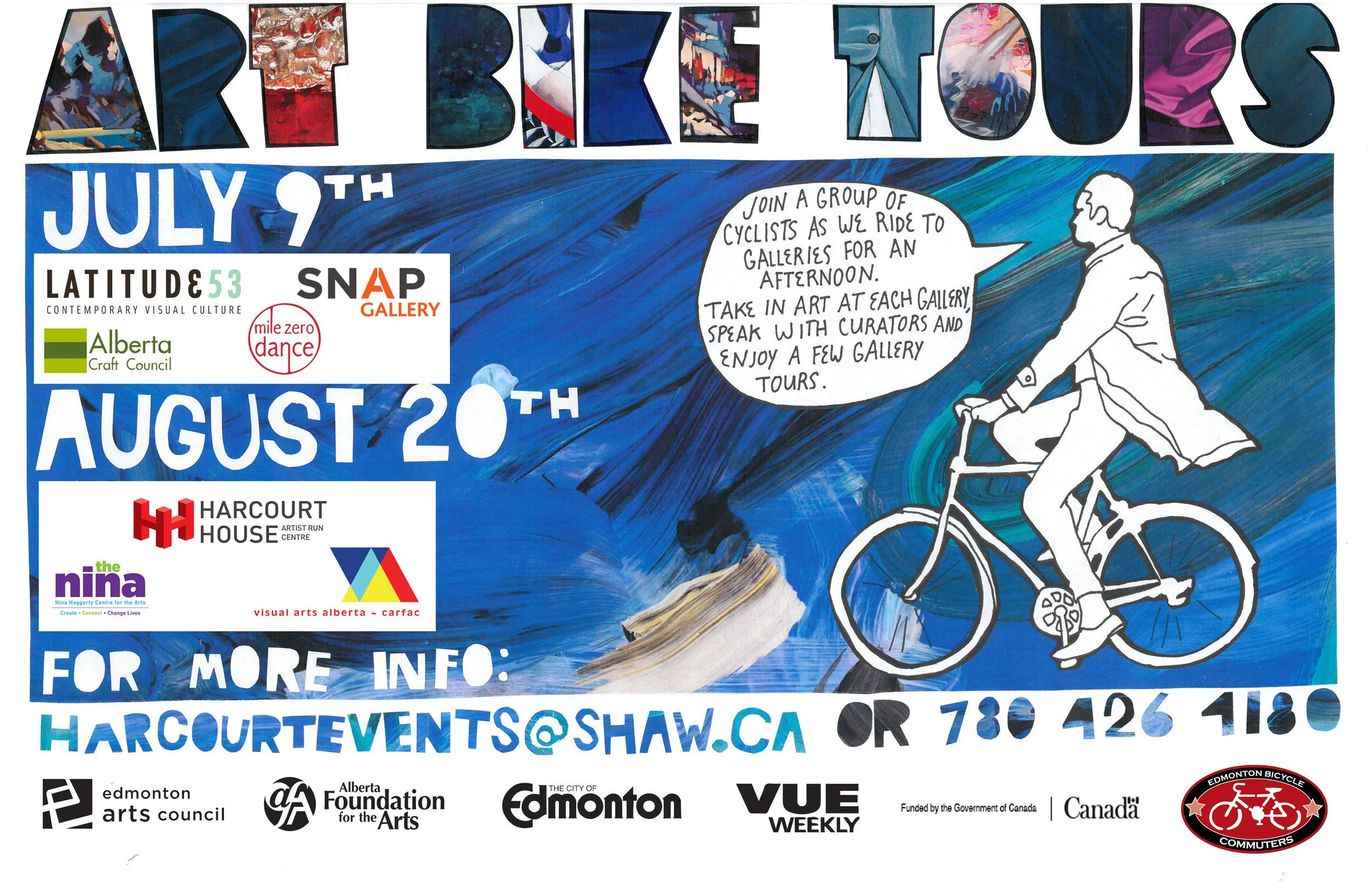
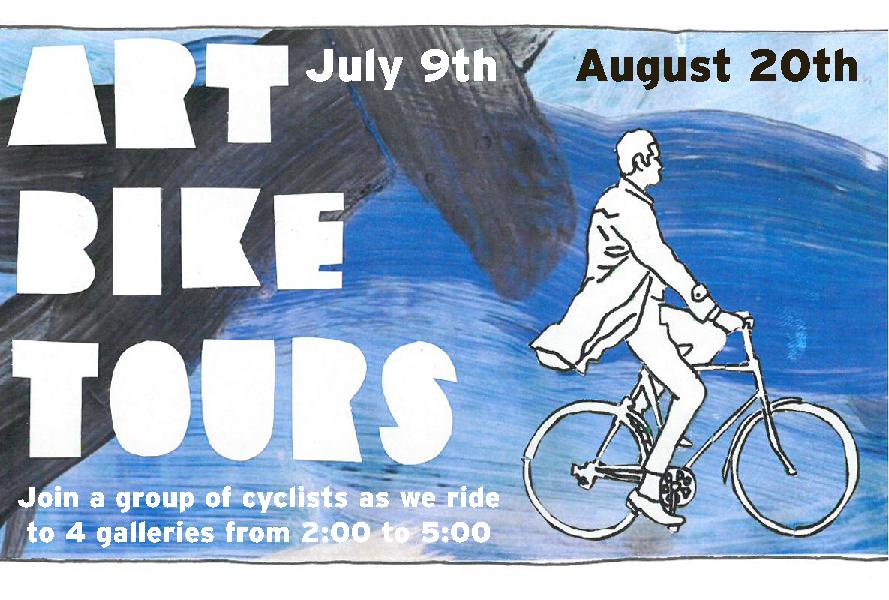
Join EBC and Harcourt House as we ride to different galleries in downtown Edmonton for an afternoon. Take in art, speak with curators and enjoy a few gallery tours.
Our schedule for Saturday, August 20:
2:00 - Nina Haggerty
2:55 - Borden Park
3:50 - CARFAC
4:25 - Harcourt House
This event is free. You are responsible for bringing your own safety gear, lock, equipment, and water. We will meet at Nina Haggerty Centre for the Arts (9225 118 Ave).
The 5th year of Sustainable Food Edmonton & Edmonton Bicycle Commuters community garden bicycle tours is happening Saturday August 20, 2016!
Discover the people power and plants production in some community gardens in north-central Edmonton. Each garden will have a host to share the stories of their garden – how the garden operates, how it came to be, and its impact on the local community.
This year's tour will be approximately 15 kms of leisurely riding. You must be comfortable with on-road cycling (light traffic only). Experienced cyclists will lead and tail the tour.
Please bring your own:
well-maintained bicycle
helmet (mandatory for under 18; recommended for 18+)
bike lock
appropriate clothing (tour runs rain or shine!)
sun protection & bug protection
water, lunch & snack
optional: cash for the purchase of fresh veggies
Registration is FREE but required
and you will be asked to sign a waiver and
photo permission form before participating.
Are you comfortable biking home at night through the river valley? Have you been the target of catcalls or other verbal harassment while riding to work? Do you worry about being run off the road or injured while running mundane errands?
Tell us your stories of being the target of harassment, threats, or aggressive driving, while riding your bicycle. And tell us about any other safety concerns you have had. Many people don't realize the adversity faced in just trying to bike somewhere: help us paint a clearer picture. Very few people will intentionally endanger another person on the road, but how do those rare instances impact your desire to ride?
You may not have the opportunity to speak to Council at a committee meeting or, but if you tell us about it, we can make sure that Council hears your story.
Share your story with us
Share your story to help us advocate for better bike infrastructure in downtown Edmonton. Please submit your incident or concern by September 9, 2016.
Additionally, if you're willing to record a short video clip of yourself (around 1-2 minutes) telling your story, we will present a compilation to Council. Upload your video to your choice of service (e.g. YouTube, Dropbox, MegaFileUpload, Facebook) and e-mail the link to [email protected].
Stantec is currently conducting a technical study of a minimum grid of physically separated bike lanes in downtown Edmonton. They will present the report to City Council's Urban Planning Committee in September 2016. The report examines using inexpensive, temporary infrastructure, such as bollards and mobile concrete curbs, to build a network of protected bike lanes, similar to Calgary’s wildly successful downtown cycle track network.
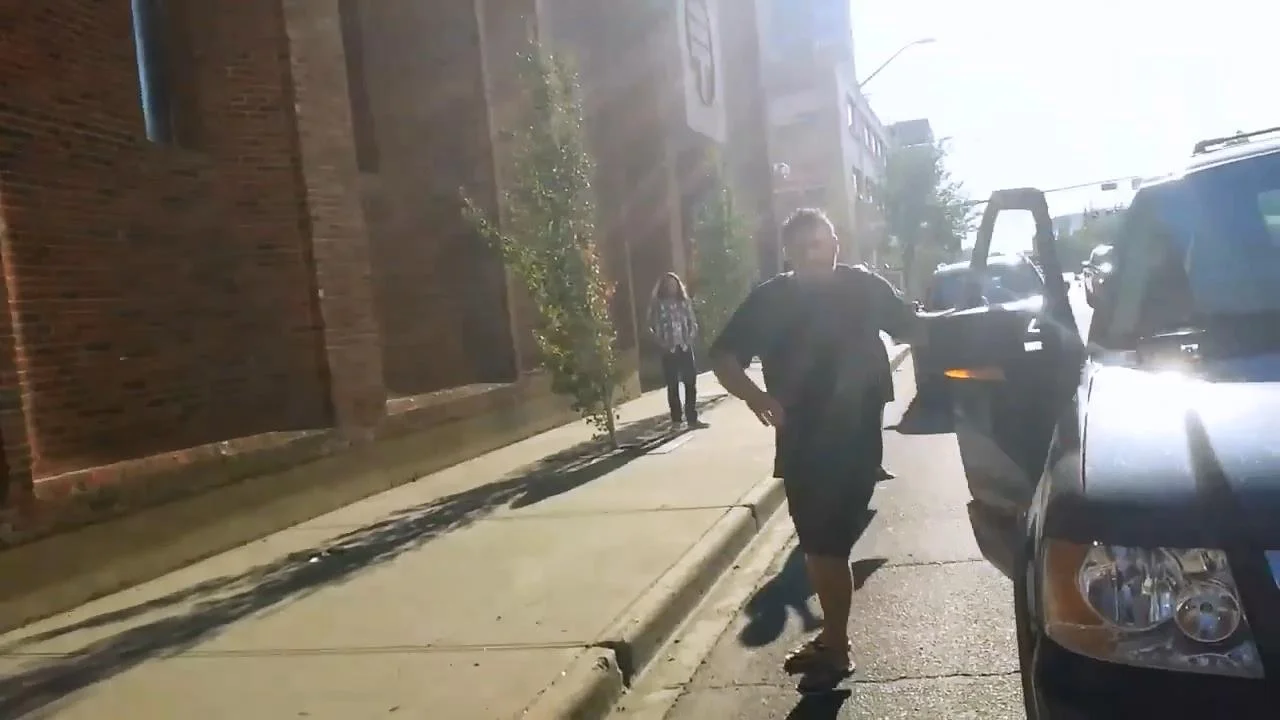
Designating space for cyclists ensures that more people have safe transportation choices and reduces conflicts between users, such as the abhorrent recent incident of racism and road rage.
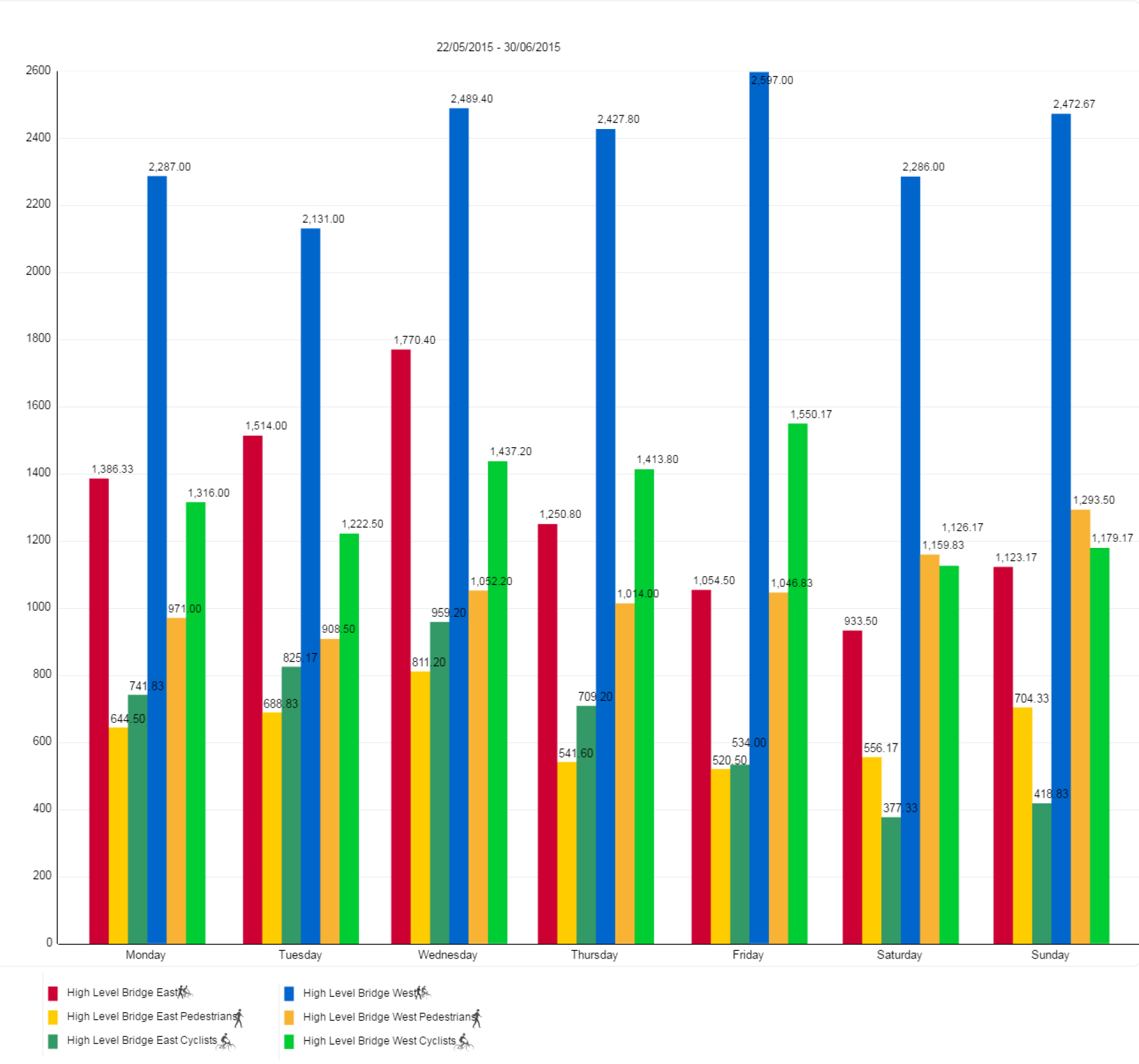
In the last two weeks, we have received nearly 60 reports of collisions or near-misses on the High Level Bridge.
In Monday's Mayor's Q & A on CBC Edmonton AM, Mayor Don Iveson was asked about safety issues on the High Level Bridge. He said, "If it becomes necessary...that we have to turn the east side into a proper sidewalk and keep the west side as the shared-use pathway that you can continue to ride, that's something that will be evaluated and decision will be made in due course."
A. It may come to that on High Level - especially on the east side -- due to the new suicide barriers causing traffic hazards
We do not support making the pathways single-use or single-direction, for several reasons:
The City is trying to encourage more people to walk and bike. During rush hour, both sides of the High Level Bridge were congested even before the installation of the suicide barriers. Now, both sides are significantly reduced in width and capacity.
The High Level Bridge is the busiest cycling route in the city, with 3000-4000 users daily, most of them on bike, sharing less than 5 metres of width between both sides of the bridge. As the city grows (in the next 25 years, downtown Edmonton’s employment will grow to 91,000) and more people walk or bike, and as more people are encouraged to ride through proper infrastructure, these numbers will just continue to grow. Further reducing the capacity of the bridge for all these users is self-defeating and directly opposes the City's own goals, visions, and efforts.
Most of the current conflicts can be resolved with courtesy and awareness for users: cyclists slowing down when passing, ringing bells, and yielding the right of way to pedestrians, with pedestrians staying to the right and single-file. This retains the flexibility for all users to access the bridge, and allows people to exercise discretion. Many of the conflicts can be reduced through education; those who are impervious to etiquette and education will also be unlikely to comply with new, unenforced rules, while the rest would be punished without benefit.
People walking their bikes across the path would further increase congestion, as more users would be bottlenecked on the bridge, and a person walking a bike is twice as wide as a mounted rider.
There are indisputable design problems with the suicide rails that increase the risk and severity of collision and injury. Both east and west sides are now below the City's own standards for minimum required widths. Addressing these problems by improving design is the correct solution: not further punishing pedestrians or cyclists because of bad design.
The intersection of Saskatchewan Drive and 109 St can take up to 3 minutes to cross from the east side to the west side, sometimes requiring waiting through 3 light cycles, which currently prioritize car traffic (including phases where cars are moving but no pedestrians are allowed to move in any direction). There are also 6 turning lanes at that intersection, which increases the risk to pedestrians and cyclists.
The traverse at the north end at 97 Ave is even worse: a walking detour of 300m and again waiting for a minimum of two light cycles to cross the streets, including a free-flow turning lane.
With access limited to one side of the bridge, many users would have to cross 109 St at both ends every time, adding 5-10 minutes just to get to the right side of the street. The narrowed pathways already deter people from walking and biking. Creating even more barriers would exacerbate the problem.
Walking your bike across the High Level Bridge adds 9 minutes to your trip compared to cycling at a moderate speed of 20km/hr.
In comparison, reducing the speed limit on Whyte Ave between 112 St and 75 St from 50 km/hr to 30 km/hr would make conditions for pedestrians, drivers, and cyclists much safer, while only adding 4 minutes of travel time (assuming free flowing traffic with no lights, a condition which never happens; in practice, the travel time change would be even less than 4 minutes):
There are several solutions that can help improve safety and comfort for pedestrians and cyclists using the bridge, without punishing either:
Put additional resources into completing the installation of the suicide barriers sooner rather than later. Construction began in September 2015 and was originally scheduled to be complete by June 2016: already a very long timeline to install two fences. As of July 12, 2016, it is still not complete. The City has announced a "tentative" opening date of July 18.
A cheap, fast safety improvement would be the installation of "rub rails": railings that are designed to protect against handlebars catching on the posts. With the right design, they can reduce the risk and severity of collisions by removing hard right angles, without further narrowing the paths.
Although it doesn't address safety issues, the user experience of the existing suicide barriers could be vastly improved by applying the City's Percent for Art program to create a more humane space, turning the imposing barriers into part of an art piece. The project had a budget of $3 million, so under the policy, up to $30,000 could potentially be available for art.
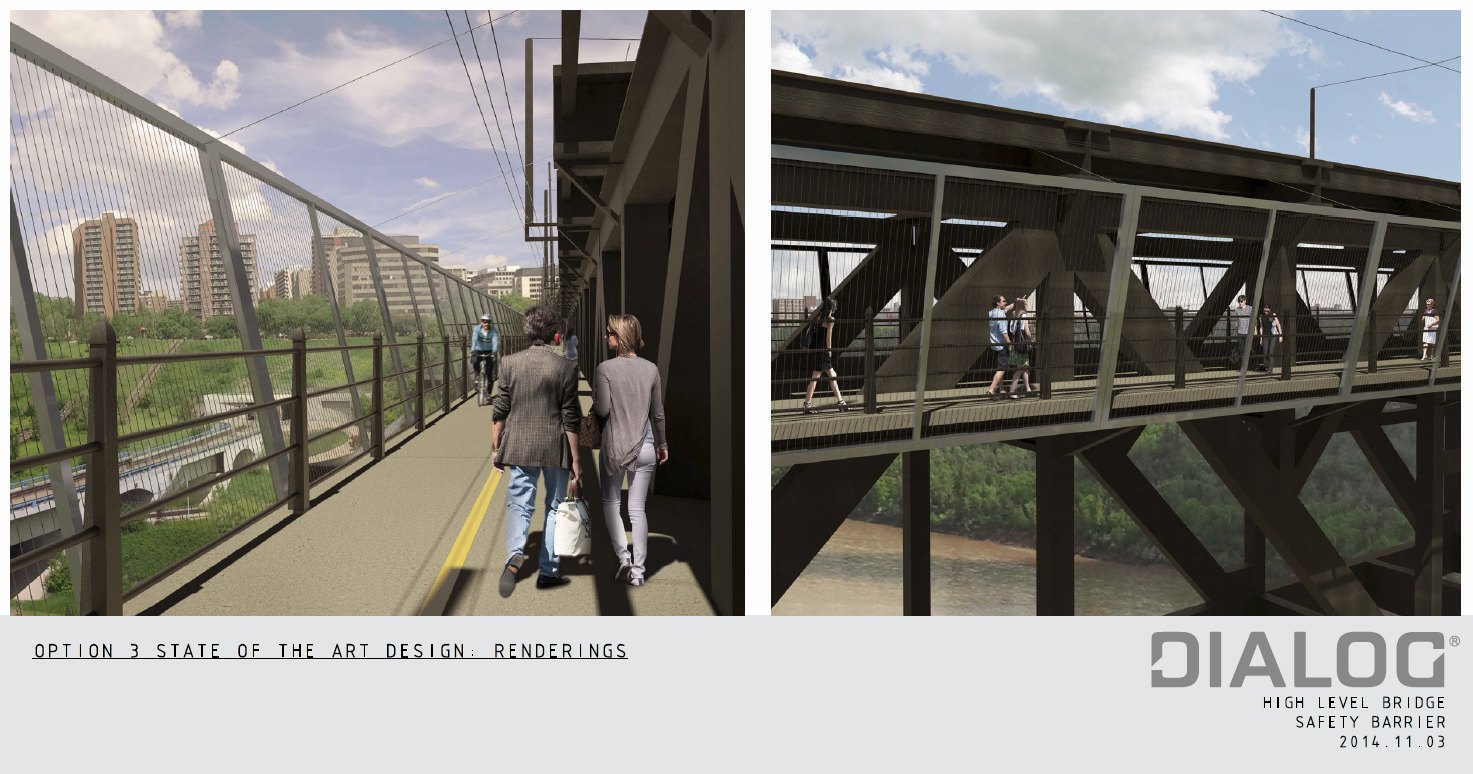
Part of the longer-term solution will be to replace the existing suicide barriers with one of the better options that were initially presented, which don't narrow the walkways:
Another advantage to this design is that it can also protect against suicide attempts from the upper deck.
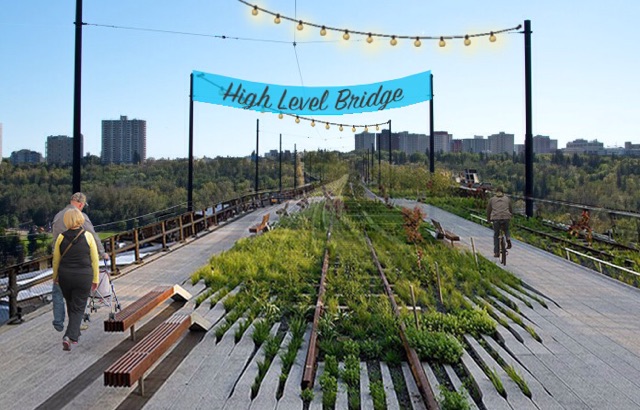
Opening the upper deck to create a park, shared with pedestrians and the streetcar, and possibly cyclists, will alleviate pressures from the side paths, while also creating a signature public space for Edmonton.
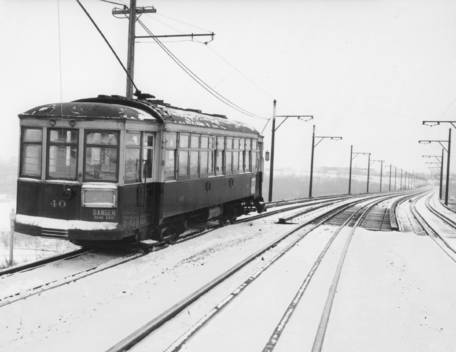
The width of the upper deck is over 10m; it used to support two streetcars and a freight train passing simultaneously:
In his Q&A, Mayor Iveson mentions that the City of Edmonton has a lease from the Province for the upper deck of the High Level Bridge, which the Province holds for the possibility of future high speed rail. We've already invested heavily to extend LRT to south Edmonton; making a rail connection at the end of the LRT line makes far more sense than blasting a high speed train through central Edmonton.
Creating a public park for all Edmontonians, including the thousands that cross the bridge daily on foot or bike, and the many thousands more who will come just to enjoy a High Level Park year-round, is a far better use of this iconic bridge.
Allan Bartman, City supervisor with Infrastructure/special projects, said of the suicide barriers, including the lack of consultation and the design's negative impact on safety and accessibility: "We take congestion and public concern seriously, and while narrowed sidewalks aren't preferable, we're happy with the project. The goal was to get supplemental railing up sooner than later, to deter suicide attempts, within the budget and timeline."
Hopefully the City can be consistent in this philosophy, and apply it to roadways as well: narrowing roadways to install protected bike lanes sooner rather than later, to prevent traffic deaths, even if it means a shorter consultation period or fewer on-street parking stalls.